
Cang Er Zi 苍耳子 — Chinese Herbal Medicine
Key Takeaways
- Nature: Warm | Taste: Acrid, Bitter
- Category: Acrid and warm exterior-releasing
- Latin: Fructus Xanthii
Cang Er Zi (苍耳子) At a Glance
- Herb: Cang Er Zi
- Chinese name: 苍耳子 (Cang Er Zi)
- Latin name: Fructus Xanthii
- Nature: Warm
- Taste: Acrid, Bitter
- Meridian: Lung
- Category: Acrid and warm exterior-releasing
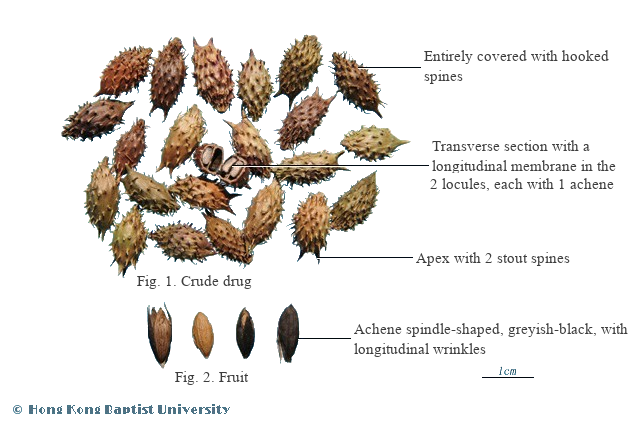
Cang Er Zi (苍耳子, Fructus Xanthii) is the dried ripe fruit of Xanthium sibiricum Patr. (Asteraceae), commonly known as cocklebur — the same plant whose burs inspired the invention of Velcro. Its name — ‘dark ear seed’ — evokes both the dark colour of the ripe fruit and possibly the ear-like shape of the bur’s hooked spines. Cang Er Zi is one of the premier nasal-disorder herbs in TCM, specifically suited for chronic conditions: it dispels Wind-Cold-Damp from the nasal passages, opens the sinuses, and drains thick, purulent discharge. Together with Xin Yi, it forms the core of Cang Er Zi San, the most widely prescribed formula for chronic rhinosinusitis. The raw fruit contains a toxic glycoside (carboxyatractyloside) and must be stir-fried (炒) to reduce toxicity while preserving the therapeutic volatile oil.
Actions & Therapeutic Effects
- Disperses Wind-Cold and opens the nasal passages — the premier herb for nasal obstruction from Wind-Cold with thick discharge and sinus congestion.
- Drains Dampness from the sinuses and treats Bi Yuan (鼻渊, deep-source nasal congestion / sinusitis) — for chronic sinusitis with purulent or mucoid discharge.
- Dispels Wind-Damp and alleviates Bi pain — treats Wind-Cold-Damp Bi syndrome, especially when affecting the upper body and head.
- Treats skin disorders from Wind — urticaria, eczema, and pruritus from Wind invasion.
Clinical Applications in TCM
- Acute and chronic rhinitis and sinusitis (Bi Yuan) with thick purulent discharge — Cang Er Zi San is the standard formula
- Allergic rhinitis with nasal congestion, sneezing, and clear discharge — combined with Xin Yi, Fang Feng, and Huang Qi (Yu Ping Feng San modification)
- Chronic sinusitis with headache, hyposmia, and purulent discharge — paired with Xin Yi, Bai Zhi, and Jin Yin Hua
- Wind-Damp Bi syndrome with upper body and head involvement — combined with Qiang Huo and Fang Feng
- Suppurative otitis media — Cang Er Zi oil ear drops (external use)
- Chronic urticaria from Wind — used with Jing Jie and Di Fu Zi
Precautions & Safety
- Dosage: 3–10 g in decoction; always use stir-fried (Chao Cang Er Zi, 炒苍耳子)
- NEVER use raw (unprocessed) Cang Er Zi — the glycoside carboxyatractyloside is hepatotoxic and nephrotoxic
- Contraindicated in Blood deficiency headache (dull, chronic headache without nasal symptoms)
- Overdose (>30 g) or prolonged use of unprocessed herb may cause liver and kidney damage
- Overdose symptoms: nausea, vomiting, abdominal pain, diarrhea, jaundice, oliguria — MEDICAL EMERGENCY
- Generally safe at recommended doses (3–10 g, stir-fried) for short- to medium-term use
Classical TCM Formulas
- Cang Er Zi San (苍耳子散): Cang Er Zi (stir-fried), Xin Yi, Bai Zhi, Bo He, Cong Bai, Xi Xin (modern: with tea) — dispels Wind, opens nasal orifices, and drains sinus discharge. Source: Ji Sheng Fang.
- Cang Er Zi You (苍耳子油): Cang Er Zi infused in sesame oil — external ear drops for suppurative otitis media.
- Xin Yi San (辛夷散) + Cang Er Zi: Xin Yi, Bai Zhi, Sheng Ma, Gao Ben, Fang Feng, Chuan Xiong, Xi Xin, Mu Tong, Gan Cao + Cang Er Zi — enhanced nasal-opening formula for severe sinusitis.
- Modified Cang Er Zi San for allergic rhinitis: Stir-fried Cang Er Zi, Xin Yi, Huang Qi, Bai Zhu, Fang Feng, Wu Wei Zi, Gan Cao — Wei Qi-stabilising anti-allergic formula.
Herb Combinations
- Cang Er Zi + Xin Yi (辛夷): the premier nasal pair — Cang Er Zi drains turbid discharge downward, Xin Yi opens the passages upward. Source: Cang Er Zi San.
- Cang Er Zi + Bai Zhi (白芷) + Bo He (薄荷): Xin Yi + Bai Zhi + Cang Er Zi for nasal congestion with frontal sinus pain and headache. Source: Cang Er Zi San.
- Cang Er Zi + Fang Feng (防风) + Qiang Huo (羌活): dispels Wind-Damp for upper-body Bi pain and allergic rhinitis.
- Cang Er Zi + Jin Yin Hua (金银花) + Lian Qiao (连翘): for chronic sinusitis with purulent yellow discharge and Heat signs.
- Cang Er Zi + Huang Qi (黄芪) + Bai Zhu (白术): for allergic rhinitis with underlying Wei Qi deficiency (with Yu Ping Feng San).
Pharmacology & Research
Nasal decongestant and anti-rhinitis: xanthium extracts reduce nasal mucosal inflammation and turbinate swelling in experimental rhinitis models.
Anti-inflammatory: suppresses COX-2 and PGE2 production; inhibits mast cell degranulation and histamine release.
Analgesic: xanthium extracts demonstrate central and peripheral analgesic activity.
Antimicrobial: volatile oil and sesquiterpene lactones show activity against Staphylococcus aureus and Streptococcus pneumoniae.
Antifungal: xanthatin and other sesquiterpene lactones demonstrate antifungal activity against Candida and Trichophyton species.
Hepatotoxic (raw form): carboxyatractyloside is a potent mitochondrial toxin that uncouples oxidative phosphorylation — the basis for toxicity; destroyed by stir-frying.
Classical Descriptions
- 《神农本草经》(Shennong Bencao Jing, circa 200 CE): “葈耳实,味甘,温。主风头寒痛,风湿周痹,四肢拘挛痛,恶肉死肌。” (Xi Er Shi [Cang Er Zi]: sweet, warm. Governs Wind-cold headache; Wind-Damp generalised Bi; spasm and contracture pain of the four limbs; malignant flesh and dead tissue.)
- 《本草纲目》(Bencao Gangmu, 1596) — Li Shizhen: “苍耳子,善通顶门连脑。” (Cang Er Zi is adept at unblocking the vertex gate, connecting to the brain.)
- 《本草备要》(Bencao Beiyao, 1694) — Wang Ang: “苍耳子,甘苦温。善发汗,散风湿,上通脑顶,下行足膝,外达皮肤。” (Cang Er Zi: sweet-bitter, warm. Adept at promoting sweating; disperses Wind-Dampness; ascends to the vertex and brain; descends to the feet and knees; reaches outward to the skin.)