
Chi Xiao Dou 赤小豆 — Chinese Herbal Medicine
Key Takeaways
- Nature: Neutral | Taste: Sweet, Acid
- Category: Eliminate urinary tract infection
- Latin: Semen Phaseoli Calcarati
Chi Xiao Dou (赤小豆) At a Glance
- Herb: Chi Xiao Dou
- Chinese name: 赤小豆 (Chi Xiao Dou)
- Latin name: Semen Phaseoli Calcarati
- Nature: Neutral
- Taste: Sweet, Acid
- Meridian: Heart
- Category: Eliminate urinary tract infection
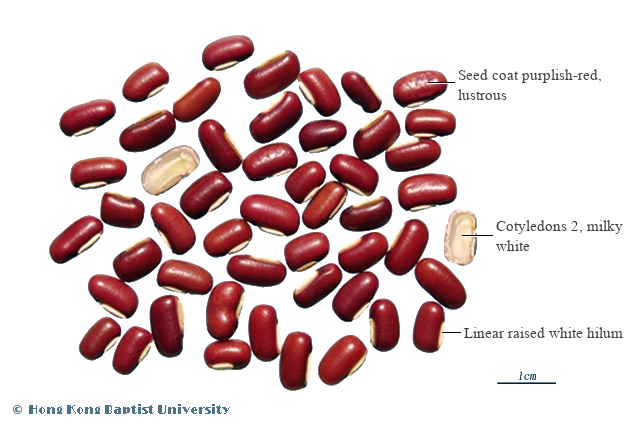
Chi Xiao Dou (赤小豆, Semen Phaseoli Calcarati) is the dried mature seed of Vigna umbellata (Thunb.) Ohwi et Ohashi (Fabaceae), commonly known as the rice bean or red adzuki bean. Harvested in autumn when the pods mature, the seeds are sun-dried. Chi Xiao Dou is distinct from the larger, more commonly eaten Hong Dou (red bean, Vigna angularis) used in desserts. Named for its small size and reddish-brown colour, this humble legume holds an important place in Chinese medicine as both food and medicine — it gently promotes urination, reduces oedema, clears Damp-Heat from the lower Jiao, and expels pus from internal abscesses. Li Shizhen praised its use in difficult-to-treat ulcers and sores. It is the core diuretic in Ma Huang Lian Qiao Chi Xiao Dou Tang, where it channels Damp-Heat outward through the urine while Lian Qiao and Ma Huang vent it through the exterior.
Actions & Therapeutic Effects
- Promotes urination and reduces oedema — drains Dampness and swelling, especially Damp-Heat oedema with concentrated urine.
- Clears Heat and resolves toxicity — treats Heat-toxin eruptive skin disorders including carbuncles, furuncles, erysipelas, and acute mastitis.
- Expels pus and disperses abscesses — internal and external abscesses, especially intestinal abscess (early appendicitis) and pulmonary abscess.
- Benefits Damp-Heat jaundice — facilitates bilirubin clearance through diuresis in Yang jaundice patterns.
Clinical Applications in TCM
- Damp-Heat jaundice with oedema — Ma Huang Lian Qiao Chi Xiao Dou Tang (Shang Han Lun)
- Early-stage appendicitis (intestinal abscess) — combined with Yi Yi Ren and Bai Jiang Cao
- Erysipelas (丹毒) and acute furunculosis — decocted alone or with Jin Yin Hua and Lian Qiao
- Oedema in pregnancy or nephritis — combined with Fu Ling Pi, Dong Gua Pi, and Ze Xie
- Pulmonary abscess with purulent sputum — paired with Yi Yi Ren and Lu Gen
- Edema in beriberi from Dampness descending — Chi Xiao Dou congee consumed regularly
- Acute mastitis in lactation — combined with Pu Gong Ying and Jin Yin Hua
Precautions & Safety
- Dosage: 10–30 g in decoction; 30–60 g in congee (cooked until soft); adequate hydration is important when used as a diuretic
- Contraindicated in Spleen deficiency with loose stools or chronic diarrhoea (its downward-moving action may worsen diarrhoea)
- Caution in Yin deficiency — the diuretic nature may further deplete fluids
- Long-term high-dose use may cause mild electrolyte disturbance — monitor with extended diuretic therapy
- Use of Chi Xiao Dou in pregnancy should be carefully monitored due to its downward-moving nature
- External application as a paste (crushed beans mixed with egg white or honey) can be used for acute inflammatory skin conditions
Classical TCM Formulas
- Ma Huang Lian Qiao Chi Xiao Dou Tang (麻黄连翘赤小豆汤): Ma Huang, Lian Qiao, Chi Xiao Dou, Xing Ren, Sheng Jiang, Da Zao, Sheng Zi Bai Pi, Gan Cao — vents Damp-Heat, treats Yang jaundice with oedema and pruritus. Source: Shang Han Lun.
- Chi Xiao Dou Tang (赤小豆汤): Chi Xiao Dou, Dong Gua Ren, Tao Ren, Yi Yi Ren — promotes pus drainage in intestinal abscess. Source: Wai Ke Zheng Zong.
- Wei Jing Tang (苇茎汤) with Chi Xiao Dou: Wei Jing (Lu Gen), Dong Gua Ren, Yi Yi Ren, Tao Ren + Chi Xiao Dou — enhanced pus-expelling formula for pulmonary abscess. Source: Bei Ji Qian Jin Yao Fang (variation).
- Chi Xiao Dou San (赤小豆散): Chi Xiao Dou, Dang Gui — topical application for initial-stage carbuncles and furuncles. Source: Classical external formula.
Herb Combinations
- Chi Xiao Dou + Ma Huang (麻黄) + Lian Qiao (连翘): vents Damp-Heat through both exterior (diaphoresis) and interior (diuresis). Source: Ma Huang Lian Qiao Chi Xiao Dou Tang.
- Chi Xiao Dou + Yi Yi Ren (薏苡仁) + Bai Jiang Cao (败酱草): expels pus and reduces abscess in intestinal abscess (appendicitis). Source: Yi Yi Fu Zi Bai Jiang San + Chi Xiao Dou.
- Chi Xiao Dou + Dong Gua Ren (冬瓜仁) + Lu Gen (芦根): drains pus and clears Heat in pulmonary abscess. Source: Wei Jing Tang variation.
- Chi Xiao Dou + Jin Yin Hua (金银花) + Lian Qiao (连翘): clears Heat-toxin and treats erysipelas, furunculosis, and acute inflammatory skin conditions.
- Chi Xiao Dou + Fu Ling Pi (茯苓皮) + Da Fu Pi (大腹皮): promotes urination and reduces generalised oedema from Dampness obstruction. Source: Classical oedema formulas.
Pharmacology & Research
Diuretic: high potassium and saponin content creates a mild osmotic diuretic effect; increases urine volume and sodium excretion.
Anti-inflammatory: flavonoid fraction (including vitexin, isovitexin) inhibits COX-2 and reduces PGE2 production in inflammatory models.
Hepatoprotective: reduces ALT and AST in models of carbon tetrachloride-induced liver injury; enhances phase II detoxification enzymes.
Lipid-lowering: dietary fibre and saponins bind bile acids in the gut, promoting cholesterol excretion and reducing serum LDL.
Antioxidant: proanthocyanidins and flavonoids in the seed coat scavenge DPPH and superoxide radicals; highest antioxidant activity is concentrated in the red pigment layer.
Antimicrobial: mild but broad-spectrum activity against Staphylococcus aureus, Pseudomonas aeruginosa, and various skin pathogens — supports its traditional topical use in furunculosis.
Classical Descriptions
- 《神农本草经》(Shennong Bencao Jing, circa 200 CE): “赤小豆,主下水,排痈肿脓血。” (Chi Xiao Dou: governs draining water downward; expels pus and blood from abscesses and swelling.)
- 《本草纲目》(Bencao Gangmu, 1596) — Li Shizhen: “赤小豆,小而色赤,心之谷也。其性下行,通乎小肠,能入阴分,治有形之病。故行津液,利小便,消胀除肿,止吐而治下痢肠澼,解酒病,除寒热痈肿,排脓散血。” (Chi Xiao Dou: small and red in colour — the grain of the Heart. Its nature is descending; it connects with the Small Intestine, can enter the yin division, and treats disorders with form. Therefore it moves fluids, promotes urination, disperses distension and reduces swelling, stops vomiting and treats dysentery and intestinal afflictions, resolves alcohol disease, eliminates cold-heat abscesses and swellings, and expels pus while scattering blood.)
- 《本草备要》(Bencao Beiyao, 1694) — Wang Ang: “赤小豆,甘酸平,色赤,心之谷也。性下行而通小肠,行水散血,消肿排脓。” (Chi Xiao Dou: sweet-sour balanced; its red colour marks it as the grain of the Heart. Its nature descends and connects with the Small Intestine; it moves water, scatters blood, disperses swelling, and expels pus.)