
Chuan Wu 川乌 — Chinese Herbal Medicine
Key Takeaways
- Nature: Hot | Taste: Acrid, Bitter
- Category: Relieves rheumatism and dispels cold.
- Latin: Radix Aconiti
Chuan Wu (川乌) At a Glance
- Herb: Chuan Wu
- Chinese name: 川乌 (Chuan Wu)
- Latin name: Radix Aconiti
- Nature: Hot
- Taste: Acrid, Bitter
- Meridian: Heart
- Category: Relieves rheumatism and dispels cold.
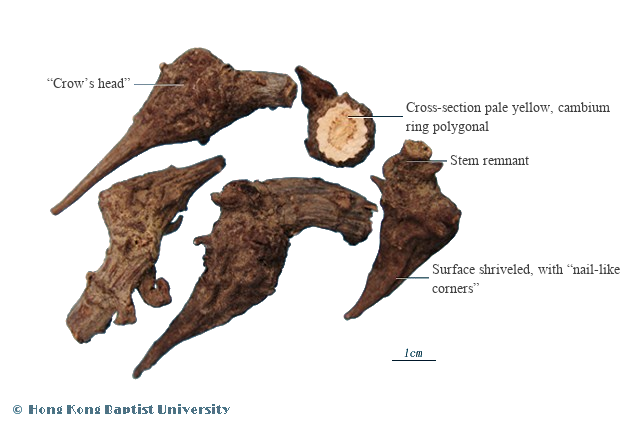
Chuan Wu (川乌, Radix Aconiti) is the dried main tuber (mother root) of Aconitum carmichaelii Debx. (Ranunculaceae), the same plant that yields Fu Zi (附子, the daughter root). Sichuan province is the genuine producing region, hence the name ‘Chuan Wu’ (Sichuan aconite). Chuan Wu is one of the most powerful and potentially toxic herbs in the Chinese pharmacopoeia, requiring meticulous processing through prolonged boiling with water, ginger, and licorice (Zhi Chuan Wu, 制川乌) to hydrolyse the highly toxic aconitine alkaloids into the far less toxic but therapeutically active benzoylaconine and aconine derivatives. It is the strongest analgesic in TCM for Cold-pattern pain, particularly severe Wind-Cold-Damp Bi syndrome with intense joint pain, cold sensation, and muscle spasms that have failed to respond to milder herbs. Its acrid-bitter-hot nature penetrates deeply into the channels, warming and unblocking where Cold has congealed.
Actions & Therapeutic Effects
- Strongly dispels Wind-Cold-Damp and alleviates severe Bi pain — the strongest TCM analgesic for Cold-pattern joint and muscle pain.
- Warms the channels and disperses Cold — treats deep Cold obstruction of the channels with severe pain and cold limbs.
- Unblocks the channels and alleviates spasms — treats muscle spasm, contracture, and numbness from Cold.
- Strong anaesthetic-analgesic activity — used topically and internally (processed) for severe pain including trigeminal neuralgia and cancer pain.
Clinical Applications in TCM
- Severe Wind-Cold-Damp Bi with intense joint pain and cold sensation — Wu Tou Tang as the classical formula
- Rheumatoid arthritis with severe deformity and cold-aggravated pain — combined with Gui Zhi, Bai Shao, and Gan Cao
- Sciatica and lumbar disc herniation with cold-type pain — processed Chuan Wu used cautiously with Dang Gui and Niu Xi
- Trigeminal neuralgia — small doses of processed Chuan Wu in carefully monitored protocols
- Cold hernia pain — Wu Tou Gui Zhi Tang for Cold-type abdominal and inguinal pain
- Topical anaesthesia — raw Chuan Wu (extremely toxic when unprocessed) was historically used as a surgical anaesthetic
Precautions & Safety
- Dosage: 1.5–3 g of processed Chuan Wu (Zhi Chuan Wu) in decoction; must be pre-decocted for 60–90 minutes before adding other herbs
- CONTRAINDICATED in pregnancy — strong toxicity and Blood-moving action
- NEVER use raw (unprocessed) Chuan Wu — always use properly processed Zhi Chuan Wu
- Contraindicated in Yin deficiency with Heat, or any Heat pattern
- Contraindicated in patients with cardiac arrhythmias or heart disease — aconitine is cardiotoxic
- Overdose symptoms: numbness and tingling of the mouth and tongue, nausea, vomiting, dizziness, arrhythmia, respiratory depression — MEDICAL EMERGENCY
- Counteracts Ban Xia, Gua Lou, Bei Mu, and Bai Ji (十八反 prohibition)
Classical TCM Formulas
- Wu Tou Tang (乌头汤): Chuan Wu (processed), Ma Huang, Bai Shao, Huang Qi, Gan Cao — severe Cold-Bi with joint pain preventing flexion and extension. Source: Jin Gui Yao Lue.
- Xiao Huo Luo Dan (小活络丹): Zhi Chuan Wu, Zhi Cao Wu, Di Long, Ru Xiang, Mo Yao, Dan Nan Xing — Wind-Cold-Damp Bi with numbness and paralysis. Source: Tai Ping Hui Min He Ji Ju Fang.
- Wu Tou Gui Zhi Tang (乌头桂枝汤): Wu Tou (processed), Gui Zhi, Bai Shao, Sheng Jiang, Da Zao, Gan Cao — Cold hernia and abdominal Cold-pain. Source: Jin Gui Yao Lue.
Herb Combinations
- Chuan Wu + Ma Huang (麻黄) + Bai Shao (白芍) + Huang Qi (黄芪): the classic Wu Tou Tang — strong Bi pain relief with Qi and Blood harmonisation. Source: Jin Gui Yao Lue.
- Chuan Wu + Gui Zhi (桂枝) + Bai Zhu (白术) + Gan Cao (甘草): warms the channels and dispels Wind-Cold-Damp for Cold-Bi. Source: Classical Bi syndrome adaptation.
- Chuan Wu + Cao Wu (草乌) (rare combination): the two aconites combined — extreme potency, only in carefully controlled processed formulas for severe, intractable Bi pain.
- Chuan Wu and Gan Cao (甘草): Gan Cao mitigates Chuan Wu toxicity while synergistically enhancing the analgesic effect.
Pharmacology & Research
Analgesic (central and peripheral): processed aconite alkaloids (benzoylaconine, aconine) produce potent dose-dependent analgesia via sodium channel modulation and central opioid system activation; efficacy in severe neuropathic and cancer pain.
Anti-inflammatory: aconite alkaloids suppress COX-2, PGE2, and TNF-α in inflammatory models; significantly reduces carrageenan and CFA-induced inflammation.
Local anaesthetic: aconitine (in raw aconite) is a potent sodium channel blocker producing reversible local anaesthesia — the basis for historical surgical anaesthetic use.
Cardiotonic (at low doses): benzoylaconine at low doses produces positive inotropic effects — but the therapeutic window is dangerously narrow.
Cardiotoxic (at overdose): aconitine produces persistent sodium channel activation, triggering ventricular arrhythmias — the mechanism of fatal toxicity.
Classical Descriptions
- 《神农本草经》(Shennong Bencao Jing, circa 200 CE): “乌头,味辛,温。主中风恶风,洗洗出汗,除寒湿痹,咳逆上气,破积聚寒热。” (Wu Tou: acrid, warm. Governs wind-strike and malign wind; promotes intermittent sweating; eliminates Cold-Damp Bi; treats cough with rebellious qi rising; breaks accumulations, cold, and heat.)
- 《本草纲目》(Bencao Gangmu, 1596) — Li Shizhen: “乌头,乃至毒之药,非风顽急疾,不可轻投。” (Wu Tou is an extremely toxic medicinal — unless for stubborn wind and urgent disease, it must not be casually administered.)
- 《本草备要》(Bencao Beiyao, 1694) — Wang Ang: “乌头,辛甘大热,有毒。搜风胜湿,开顽痰,治顽疮,以毒攻毒。” (Wu Tou: acrid-sweet, greatly hot, toxic. Searches out Wind and overcomes Dampness; opens stubborn Phlegm; treats intractable sores — treating toxin with toxin.)