
Cong Bai 葱白 — Chinese Herbal Medicine
Key Takeaways
- Nature: Warm | Taste: Acrid
- Category: Acrid and warm exterior-releasing
- Latin: Bulbus Allii Fistulosi (Scallion White)
Cong Bai (葱白) At a Glance
- Herb: Cong Bai
- Chinese name: 葱白 (Cong Bai)
- Latin name: Bulbus Allii Fistulosi (Scallion White)
- Nature: Warm
- Taste: Acrid
- Meridian: Lung
- Category: Acrid and warm exterior-releasing
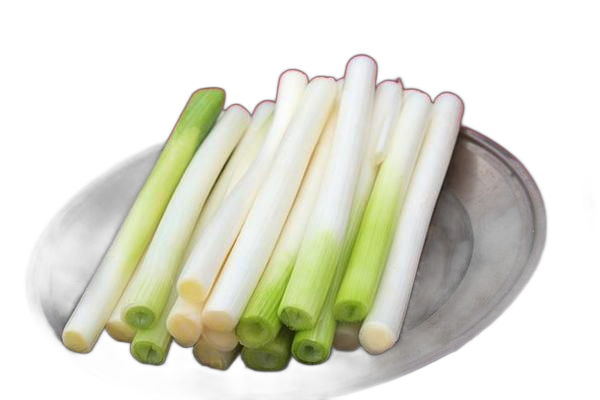
Cong Bai (葱白, Bulbus Allii Fistulosi) is the fresh white basal stem of Allium fistulosum L. (Liliaceae/Alliaceae), commonly known as the scallion or Welsh onion. It is one of the humblest yet most versatile medicines in the Chinese pharmacopoeia — a daily kitchen staple that, applied at the right moment, can abort an incipient common cold before it fully develops. Its acrid-warm character releases the exterior, disperses Cold, and possesses the unusual ability to ‘unblock Yang’ (通阳) — restoring communication between the exterior and interior when pathogenic Cold has obstructed the flow of Yang Qi. Zhang Zhongjing used it in Bai Tong Tang to rescue devastated Yang in Shao Yin disease with interior Cold rejecting exterior Heat. Cong Bai also guides other herbs upward and outward, similar to but milder than Sheng Ma. It is typically used fresh (undried), and its volatile, aromatic nature means it should be added at the end of decoction.
Actions & Therapeutic Effects
- Releases the exterior and disperses Cold — primary action for early-stage Wind-Cold with chills, low-grade fever, headache, and nasal congestion; most effective when taken at the very first sign of a cold.
- Unblocks Yang and disperses Cold obstruction — restores the communication of Yang Qi between interior and exterior when pathogenic Cold severs this connection (e.g., Shao Yin disease with interior Cold rejecting exterior Heat).
- Warms the channels and guides herbs outward — acts as an envoy herb that directs formula action to the exterior.
- Resolves early-stage external abscesses and boils — topical application of crushed fresh Cong Bai draws out Heat-toxin from initial-stage carbuncles and furuncles (similar mechanism to dispersing externally).
- Warms the Middle and promotes the descent of rebellious Qi — mild stomach-warming and anti-nausea effect; also promotes lactation.
Clinical Applications in TCM
- First sign of common cold (Wind-Cold) — Cong Bai decoction with light-brown sugar (Cong Chi Tang with Dan Dou Chi) or simply fresh scallion tea
- Wind-Cold headache and nasal congestion — Cong Bai decocted with Sheng Jiang
- Shao Yin disease with interior Cold rejecting exterior Heat (真寒假热) — Bai Tong Tang (Cong Bai + Gan Jiang + Fu Zi) from Shang Han Lun
- Urinary obstruction from Bladder Qi transformation failure — crushed Cong Bai applied as a warm compress to the lower abdomen promotes urination
- Early-stage furuncle or abscess — crushed fresh Cong Bai mixed with honey and applied topically as a poultice
- Abdominal Cold pain and distension — Cong Bai roasted and applied to the umbilicus with moxibustion or as a warm compress
- Postpartum urinary retention — freshly crushed Cong Bai applied as a warm compress below the umbilicus
Precautions & Safety
- Dosage: 3–10 g (2–3 stalks) in decoction; add near the end (aromatic, volatile nature — prolonged decoction destroys the active volatiles)
- Contraindicated in exterior Heat patterns or interior Excess Heat
- Contraindicated in spontaneous sweating from exterior deficiency
- Do not combine with honey internally (classical ‘十八反’ food prohibition for Cong Bai + honey, though the evidence is largely traditional)
- Caution in patients with profuse sweating or dehydration — the diaphoretic action may worsen fluid loss
- Fresh scallion is preferred to dried; wilted or slimy specimens should be discarded
- In Bai Tong Tang, the Cong Bai is used specifically for its Yang-unblocking action, not for exterior release
Classical TCM Formulas
- Cong Chi Tang (葱豉汤): Cong Bai, Dan Dou Chi — releases the exterior for early-stage Wind-Cold with mild symptoms. Source: Zhou Hou Bei Ji Fang.
- Bai Tong Tang (白通汤): Cong Bai (4 stalks), Gan Jiang (3 liang), Fu Zi (1 piece) — unblocks Yang and breaks Yin for Shao Yin disease with severe Cold obstruction. Source: Shang Han Lun.
- Bai Tong Jia Zhu Dan Zhi Tang (白通加猪胆汁汤): Bai Tong Tang plus human urine (modern: Zhu Dan Zhi / pig bile) — for Shao Yin disease with vomiting and diarrhea where Yang is blocked. Source: Shang Han Lun.
- Huo Ren Cong Chi Tang (活人葱豉汤): Cong Bai, Dan Dou Chi, Ma Huang, Ge Gen — stronger acute exterior release for Wind-Cold. Source: Lei Zheng Huo Ren Shu.
Herb Combinations
- Cong Bai + Dan Dou Chi (淡豆豉): the classic mild exterior-releasing pair — for early-stage Wind-Cold or Wind-Heat (depending on accompaniment). Source: Cong Chi Tang (Zhou Hou Bei Ji Fang).
- Cong Bai + Sheng Jiang (生姜) + brown sugar: classic home remedy for early-stage common cold with nasal congestion and chills. Source: Folk tradition.
- Cong Bai + Gan Jiang (干姜) + Fu Zi (附子): unblocks Yang and breaks Yin-Cold obstruction for Shao Yin disease with true Cold-false Heat. Source: Bai Tong Tang (Shang Han Lun).
- Cong Bai + Xing Ren (杏仁) + Jie Geng (桔梗): releases exterior Cold and stops cough with chest oppression.
- Cong Bai + Dong Gua Zi (冬瓜子): external warm compress to promote urination in postpartum retention or acute urinary obstruction.
Pharmacology & Research
Antimicrobial: allicin and diallyl sulfides exhibit broad-spectrum antibacterial activity against Staphylococcus aureus, Streptococcus pneumoniae, and Haemophilus influenzae — supports traditional use in early upper respiratory infections.
Diaphoretic: promotes mild sweating through peripheral vasodilation — the volatile sulfur compounds stimulate thermoregulatory centres and sweat gland activity.
Nasal decongestant: volatile sulfur-containing compounds stimulate trigeminal nerve endings in the nasal mucosa, producing reflex vasoconstriction and decongestion.
Anti-inflammatory: quercetin and kaempferol glycosides inhibit COX and LOX pathways; reduces carrageenan-induced inflammation in animal models.
Antiplatelet: allicin and adenosine inhibit platelet aggregation and promote fibrinolysis — the biochemical basis for ‘unblocking Yang’ in microcirculatory stasis.
Lipid-lowering: diallyl disulfide reduces hepatic HMG-CoA reductase activity; modest but consistent cholesterol-lowering effect.
Classical Descriptions
- 《神农本草经》(Shennong Bencao Jing, circa 200 CE): “葱白,味辛,温。主伤寒寒热,出汗,中风面目肿。” (Cong Bai: acrid, warm. Governs cold damage with chills and fever; promotes sweating; treats wind strike with swelling of the face and eyes.)
- 《本草纲目》(Bencao Gangmu, 1596) — Li Shizhen: “葱,所治之症,多属太阴、阳明,皆取其发散通气之功。通气故能解毒及理血病。气者,血之帅也,气通则血活矣。” (Cong: the conditions it treats mostly belong to Tai Yin and Yang Ming; all utilise its function of dispersing and unblocking qi. Unblocking qi enables it to resolve toxins and regulate blood diseases. Qi is the commander of Blood; when Qi flows freely, Blood is invigorated.)
- 《本草备要》(Bencao Beiyao, 1694) — Wang Ang: “葱白,辛温,发表通阳。治伤寒头痛,阴毒腹痛,通乳汁,散乳痈,利耳鸣,通二便。” (Cong Bai: acrid-warm; releases the exterior and unblocks Yang. Treats cold-damage headache, yin-toxin abdominal pain; promotes lactation, disperses breast abscess; benefits tinnitus; unblocks urination and defecation.)