
Da Fu Pi 大腹皮 — Chinese Herbal Medicine
Key Takeaways
- Nature: Warm | Taste: Acrid
- Category: Regulate the qi
- Latin: Pericarpium Arecae
Da Fu Pi (大腹皮) At a Glance
- Herb: Da Fu Pi
- Chinese name: 大腹皮 (Da Fu Pi)
- Latin name: Pericarpium Arecae
- Nature: Warm
- Taste: Acrid
- Meridian: Spleen
- Category: Regulate the qi
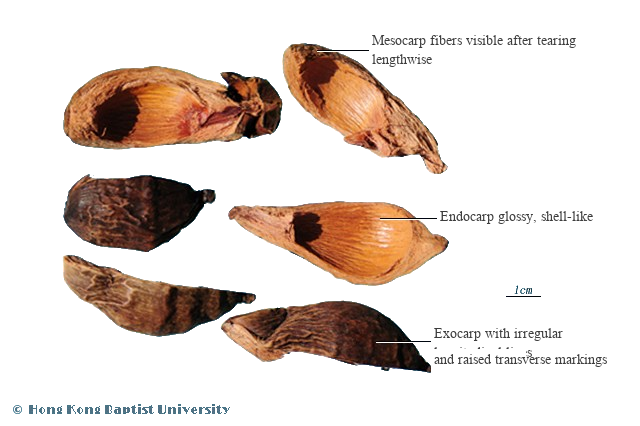
Da Fu Pi (大腹皮, Pericarpium Arecae) is the dried fibrous husk (pericarp) of the ripe fruit of Areca catechu L. (Palmae/Arecaceae), the areca palm or betel nut palm. Harvested from winter to the following spring, the fruit is boiled, and the husk is stripped, beaten, and dried. The name ‘Da Fu Pi’ — ‘big belly skin’ — is a vivid description of both its physical appearance (the husk that encloses the betel nut) and its clinical function: reducing abdominal distension (the ‘big belly’). It is the husk counterpart to Bing Lang (槟榔, Semen Arecae, the seed), and while both share Qi-moving and water-draining properties, Da Fu Pi is notably stronger at moving Qi and reducing distension while being milder at the purgative and anti-parasitic actions that define Bing Lang. Its acrid-warm nature and light, dispersing quality make it effective for Dampness obstruction with Qi stagnation in the Middle and Lower Jiao.
Actions & Therapeutic Effects
- Moves Qi and reduces abdominal distension — primary action; treats severe abdominal distension and fullness from Qi stagnation, especially with Dampness.
- Promotes urination and reduces oedema — mild diuretic action, treating oedema, leg Qi (beriberi), and Dampness-induced swelling.
- Descends Qi and unblocks the bowels — mild purgative action that treats constipation from Qi and Dampness obstruction.
- Treats beriberi (脚气) from Dampness descending — traditional use for leg oedema, heaviness, and numbness from Dampness.
Clinical Applications in TCM
- Severe abdominal distension and fullness from Qi stagnation with Dampness — combined with Hou Po, Mu Xiang, and Chen Pi
- Ascites and abdominal oedema from Dampness obstruction — paired with Fu Ling Pi, Dong Gua Pi, and Ze Xie
- Constipation with abdominal distension from Qi and Dampness — used with Zhi Shi and Bing Lang
- Beriberi (leg Qi) with oedema and heaviness — combined with Mu Gua and Yi Yi Ren
- Chest and hypochondriac distension from Qi and Dampness — paired with Chai Hu and Qing Pi
- Post-surgical abdominal ileus — used with Hou Po and Da Huang in integrative protocols
Precautions & Safety
- Dosage: 5–10 g in decoction
- Contraindicated in Qi deficiency without stagnation — the strong Qi-moving action may deplete
- Contraindicated in pregnancy without clear indication — the descending Qi action may affect fetal stability
- Caution in patients with chronic diarrhea or Spleen deficiency
- Do not substitute for Bing Lang when the anti-parasitic or stronger purgative action is needed
- Long-term use may cause dry mouth and throat — the warming, drying nature affects fluids
Classical TCM Formulas
- Ji Ming San (鸡鸣散): Bing Lang, Mu Gua, Wu Zhu Yu, Chen Pi, Zi Su Ye, Jie Geng, Sheng Jiang, Da Fu Pi (often added) — treats beriberi with leg oedema and Dampness descending. Source: Zheng Zhi Zhun Sheng.
- Da Fu Pi San (大腹皮散): Da Fu Pi, Chen Pi, Hou Po, Mu Xiang, Gan Cao, Sheng Jiang — moves Qi and reduces distension for abdominal fullness. Source: Tai Ping Sheng Hui Fang.
- Wu Pi San (五皮散): Fu Ling Pi, Da Fu Pi, Wu Jia Pi, Sheng Jiang Pi, Chen Pi (or Di Gu Pi) — drains Dampness and reduces oedema. Source: Hua Tuo Zhong Cang Jing.
Herb Combinations
- Da Fu Pi + Hou Po (厚朴) + Mu Xiang (木香): moves Qi and reduces distension for severe abdominal fullness from Qi and Dampness obstruction. Source: Classical Qi-regulating combinations.
- Da Fu Pi + Fu Ling Pi (茯苓皮) + Dong Gua Pi (冬瓜皮): the ‘triple peel’ combination — drains Dampness and reduces oedema from the Lower Jiao. Source: Classical oedema formulas.
- Da Fu Pi + Zi Su Geng (紫苏梗) + Sha Ren (砂仁): moves Qi and harmonises the Middle during pregnancy with distension — a safer pregnancy-compatible combination when individually assessed.
- Da Fu Pi + Bing Lang (槟榔) + Mu Gua (木瓜): treats beriberi with leg oedema and Dampness. Source: Ji Ming San.
- Da Fu Pi + Zhi Shi (枳实) + Lai Fu Zi (莱菔子): strongly moves Qi and descends for constipation with abdominal distension from food and Qi stagnation.
Pharmacology & Research
Gastrointestinal prokinetic: arecoline (from the husk, though in lower concentration than the seed) stimulates gastrointestinal smooth muscle via cholinergic receptor activation; increases gastric emptying and intestinal transit.
Diuretic: promotes sodium and water excretion through mild renal tubular effects; the exact mechanism remains partially characterised.
Antimicrobial: areca alkaloids demonstrate activity against intestinal parasites (tapeworms, roundworms) — although much weaker than the seed (Bing Lang), some anti-parasitic activity is retained.
Antifibrotic: areca polyphenols reduce hepatic stellate cell activation and collagen deposition in experimental liver fibrosis models.
Vasodilatory: arecoline produces endothelium-dependent vasodilation at low concentrations.
Classical Descriptions
- 《开宝本草》(Kai Bao Ben Cao, 973 CE): “大腹皮,味辛,微温。主冷热气攻心腹,大肠壅毒,痰膈醋心。” (Da Fu Pi: acrid, slightly warm. Governs cold and heat qi assailing the Heart and abdomen, large intestine congestive toxin, and Phlegm-obstructed diaphragm with acid regurgitation.)
- 《本草纲目》(Bencao Gangmu, 1596) — Li Shizhen: “大腹皮,降逆气,消肌肤中水气浮肿,脚气壅逆,瘴疟痞满,胎气恶阻胀闷。” (Da Fu Pi: descends rebellious Qi; disperses water qi and oedema in the skin and flesh; treats beriberi with congestive counterflow, miasmic malaria with stuffiness and fullness, and fetal qi [pregnancy] with malign obstruction, distension, and oppression.)
- 《本草备要》(Bencao Beiyao, 1694) — Wang Ang: “大腹皮,辛温。下气行水。治水肿脚气,痞满膨胀。” (Da Fu Pi: acrid-warm. Descends qi and moves water. Treats oedema and beriberi, stuffiness, fullness, and distension.)