
Du Huo 独活 — Chinese Herbal Medicine
Key Takeaways
- Nature: Slight Warm | Taste: Acrid, Bitter
- Category: Relieves rheumatism and dispels cold.
- Latin: Radix Angelicae Pubescentis
Du Huo (独活) At a Glance
- Herb: Du Huo
- Chinese name: 独活 (Du Huo)
- Latin name: Radix Angelicae Pubescentis
- Nature: Slight Warm
- Taste: Acrid, Bitter
- Meridian: Lung
- Category: Relieves rheumatism and dispels cold.
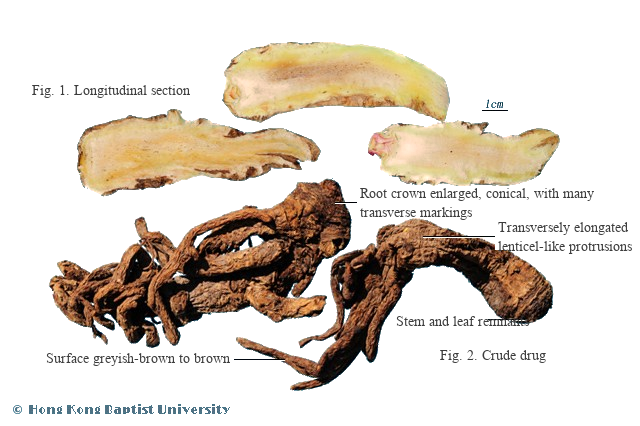
Du Huo (独活, Radix Angelicae Pubescentis) is the dried root of Angelica pubescens Maxim. f. biserrata Shan et Yuan (Apiaceae), harvested in early spring or late autumn when the aerial parts have withered. Its name—’independent existence’—alludes to its ability to grow alone in high-altitude, wind-swept environments, reflecting its clinical strength in dispelling Wind-Damp from deep within the channels. Du Huo targets the lower body preferentially: lumbar pain, knee weakness, and chronic Bi syndrome of the legs. Though often paired with Qiang Huo (which targets the upper body), Du Huo is milder and more suited to chronic, deep-seated Bi pain with underlying Kidney deficiency, especially in aging patients. It also possesses a mild exterior-releasing action useful when Wind-Cold-Damp invades through a weakened defensive surface.
Actions & Therapeutic Effects
- Dispels Wind-Damp and alleviates pain — primary action; especially effective for chronic, deep-seated Bi pain in the lumbar spine, hips, knees, and legs.
- Disperses Cold and releases the exterior — mild exterior-releasing action for Wind-Cold-Damp invasion with general body aches and headache.
- Targets the lower body — preferential action on the lower Jiao and lower limb channels, distinguishing it from Qiang Huo which targets the upper body.
- Calms pain from Shao Yin (Kidney) channel involvement — deep-seated pain associated with chronic Bi in the elderly, often rooted in Kidney deficiency.
Clinical Applications in TCM
- Chronic lumbar pain and leg weakness from Wind-Damp with Kidney deficiency — Du Huo Ji Sheng Tang (Bei Ji Qian Jin Yao Fang)
- Acute Wind-Cold-Damp Bi with generalised body aches and headache — paired with Qiang Huo, Fang Feng, and Chuan Xiong
- Sciatica and lumbar disc herniation with cold-damp signs — combined with Wei Ling Xian, Niu Xi, and Dang Gui
- Knee osteoarthritis aggravated by cold weather — paired with Du Zhong, Niu Xi, and Wu Jia Pi
- Facial nerve paralysis (Bell’s palsy) from Wind-Cold striking the channels — used with Fang Feng and Bai Fu Zi
- Headache from Wind-Cold-Damp — especially occipital and vertex headache associated with cold-damp Bi syndrome
Precautions & Safety
- Dosage: 3–10 g in decoction; higher doses (up to 15 g) for severe Bi pain
- Contraindicated in yin deficiency with internal heat or blood deficiency generating wind
- Caution in patients with gastric ulcers — volatile oil components may irritate gastric mucosa
- May cause photosensitivity in susceptible individuals (furanocoumarin content)
- Avoid during pregnancy or use only under strict supervision (mild uterine stimulant effect)
Classical TCM Formulas
- Du Huo Ji Sheng Tang (独活寄生汤): Du Huo, Sang Ji Sheng, Du Zhong, Niu Xi, Xi Xin, Qin Jiao, Fu Ling, Rou Gui, Fang Feng, Chuan Xiong, Ren Shen, Gan Cao, Dang Gui, Bai Shao, Sheng Di Huang — the premier formula for chronic Bi pain with Liver-Kidney deficiency. Source: Bei Ji Qian Jin Yao Fang.
- Qiang Huo Sheng Shi Tang (羌活胜湿汤): Qiang Huo, Du Huo, Gao Ben, Fang Feng, Chuan Xiong, Man Jing Zi, Zhi Gan Cao — dispels Wind-Damp from the exterior for headache and body aches. Source: Nei Wai Shang Bian Huo Lun.
- Du Huo San (独活散): Du Huo, Bai Zhu, Fang Feng, Xi Xin — Wind-Damp Bi with heavy sensation and numbness. Source: Tai Ping Sheng Hui Fang.
Herb Combinations
- Du Huo + Qiang Huo (羌活): the classic pair — Du Huo targets lower body, Qiang Huo targets upper body; together cover whole-body Wind-Damp Bi pain. Source: Qiang Huo Sheng Shi Tang (Nei Wai Shang Bian Huo Lun).
- Du Huo + Fang Feng (防风) + Xi Xin (细辛) + Chuan Xiong (川芎): scatters Wind, dispels Dampness, and activates Blood for deep-seated Bi pain. Source: Du Huo Ji Sheng Tang.
- Du Huo + Du Zhong (杜仲) + Niu Xi (牛膝): tonifies Kidney-Liver and dispels Wind-Damp — ideal for chronic lumbar pain in the elderly. Source: Du Huo Ji Sheng Tang.
- Du Huo + Wei Ling Xian (威灵仙) + Hai Feng Teng (海风藤): channels and collaterals — strong Wind-Damp dispelling for joint pain and numbness. Source: Classical Bi syndrome combinations.
- Du Huo + Gui Zhi (桂枝) + Bai Shao (白芍): releases exterior and harmonises Ying-Wei while targeting joint pain — appropriate when Bi syndrome coexists with exterior invasion. Source: Classical Shang Han Lun adaptations.
Pharmacology & Research
Anti-inflammatory: osthol and columbianadin inhibit COX-1/COX-2 and reduce prostaglandin E2 production; comparable to indomethacin in some animal models of acute inflammation.
Analgesic: osthol demonstrates dose-dependent analgesic activity via central and peripheral mechanisms; significant reduction in formalin-induced pain behaviours in rodents.
Vasodilatory and antihypertensive: calcium channel blocking activity in vascular smooth muscle; reduces peripheral vascular resistance.
Sedative and anticonvulsant: GABAergic modulation; prolongs barbiturate-induced sleep time in animal models.
Photosensitising: furanocoumarins (bergapten, xanthotoxin) intercalate DNA upon UV exposure — therapeutic for vitiligo but warrants sun-exposure caution.
Osteoprotective: inhibits osteoclast differentiation and bone resorption via RANKL pathway modulation.
Classical Descriptions
- 《神农本草经》(Shennong Bencao Jing, circa 200 CE): “独活,味苦,平。主风寒所击,金疮止痛,贲豚,痫痓,女子疝瘕。久服轻身耐老。” (Du Huo: bitter, balanced. Governs [syndromes from] Wind-Cold assault; relieves pain from metal-inflicted wounds; treats Running Piglet Qi; treats epilepsy and convulsions; treats female hernial masses. Long-term use lightens the body and slows ageing.)
- 《本草纲目》(Bencao Gangmu, 1596) — Li Shizhen: “独活、羌活,乃一类二种,以他地者为独活,西羌者为羌活。独活气细,羌活气雄。” (Du Huo and Qiang Huo are one category with two varieties; that from central China is Du Huo, that from western Qiang regions is Qiang Huo. Du Huo qi is fine and gentle; Qiang Huo qi is bold and strong.)
- 《本草备要》(Bencao Beiyao, 1694) — Wang Ang: “独活,辛苦微温,入肾经气分,理伏风,去风湿,疗诸贼风,百节痛风,无问久新。” (Du Huo: acrid-bitter, slightly warm; enters the Kidney channel qi division; regulates latent Wind, dispels Wind-Damp, treats various damaging wind conditions, hundred-joint wind-pain, whether chronic or recent.)