
Gan Sui 甘遂 — Chinese Herbal Medicine
Key Takeaways
- Nature: Cold | Taste: Bitter, Sweet
- Category: strong purgatives and diuretics
- Latin: Radix Euphorbiae Kansui
Gan Sui (甘遂) At a Glance
- Herb: Gan Sui
- Chinese name: 甘遂 (Gan Sui)
- Latin name: Radix Euphorbiae Kansui
- Nature: Cold
- Taste: Bitter, Sweet
- Meridian: Lung
- Category: strong purgatives and diuretics
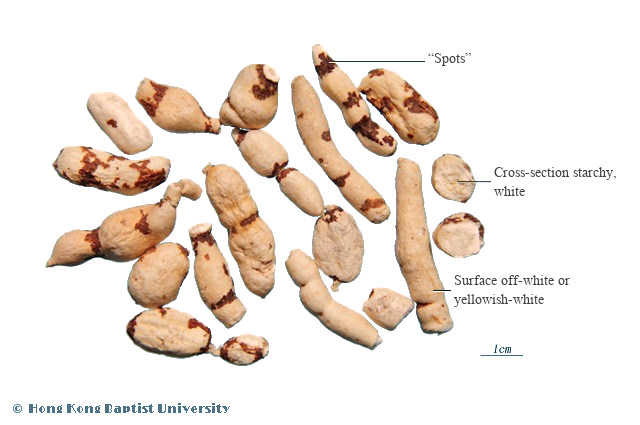
Gan Sui (甘遂, Radix Euphorbiae Kansui) is the dried tuberous root of Euphorbia kansui T.N. Liou ex T.P. Wang (Euphorbiaceae), harvested in spring before the aerial parts emerge or in autumn after they wither. First recorded in the Shennong Bencao Jing as a lower-grade herb, Gan Sui is among the most powerful and potentially toxic diuretic-purgatives in the Chinese pharmacopoeia — a ‘hydragogue cathartic’ (逐水药) that aggressively drives accumulated water from the body through both the intestines (producing violent watery diarrhoea) and the kidneys (producing profuse urination). It is reserved for extreme conditions of water-dampness accumulation — severe ascites, pleural effusion, and anasarca — where gentler diuretics have failed and the patient still has sufficient constitutional strength to withstand the drastic purgation. Zhang Zhongjing’s Shi Zao Tang (Ten Jujube Decoction) is the classical delivery method: Gan Sui, Yuan Hua, and Da Ji powders are taken with a decoction of ten jujube dates (Da Zao), whose sweet, moderating nature partially protects the Spleen-Stomach from the harsh attack. Do NOT confuse Gan Sui (甘遂, ‘sweet pursuit’) with Gan Cao (甘草, licorice) — they are 十八反 (Eighteen Antagonisms) incompatible and must never be combined.
Actions & Therapeutic Effects
- Strongly drains water accumulation through both purgation and diuresis — the primary action; treats severe ascites, pleural effusion, and generalised oedema. The strongest hydragogue cathartic in the materia medica.
- Drives out water and reduces swelling — treats anasarca with abdominal distension, scanty urine, and constipation.
- Breaks up Phlegm-fluid retention (逐饮) — treats pleural effusion (Xuan Yin, 悬饮) with chest and hypochondriac pain.
- Reduces Heat and disperses swelling — treats Damp-Heat accumulations with constipation and oedema.
Clinical Applications in TCM
- Severe ascites from liver cirrhosis — Shi Zao Tang (Gan Sui + Yuan Hua + Da Ji powders in Da Zao decoction)
- Pleural effusion (Xuan Yin) with chest and hypochondriac pain — Shi Zao Tang is the classical formula
- Generalised anasarca with scanty urine and constipation — Gan Sui powder in very small doses
- Intestinal water-accumulation with abdominal distension and pain — combined with Da Huang and Qian Niu Zi in carefully monitored protocols
- Damp-Heat abdominal masses with water retention — used in controlled integrative settings
- Modern application: Gan Sui is largely reserved for hospital-based, closely monitored treatment of severe, drug-resistant ascites and effusion; rarely used in outpatient settings
Precautions & Safety
- Dosage: 0.5–1.5 g as powder (processed, vinegar-prepared); NEVER exceed recommended dose
- Must be processed (醋制): vinegar-prepared Gan Sui (Cu Gan Sui, 醋甘遂) to reduce toxicity
- ALWAYS combine with Da Zao (Jujube dates) to moderate the harsh effect and protect the Stomach
- CONTRAINDICATED in pregnancy — extremely dangerous: causes violent purgation and uterine contraction
- CONTRAINDICATED in any deficiency pattern, weak constitution, or dehydrated patient
- CONTRAINDICATED with Gan Cao (甘草) — Eighteen Antagonisms (十八反) prohibition: they form toxic precipitates
- Overdose symptoms: severe, uncontrollable watery diarrhoea, haematochezia, dehydration, electrolyte imbalance, shock, acute renal failure — MEDICAL EMERGENCY
- Not for use in patients with intestinal obstruction, gastrointestinal bleeding, or renal impairment
- This herb is restricted in many jurisdictions
Classical TCM Formulas
- Shi Zao Tang (十枣汤): Yuan Hua (powder), Gan Sui (powder), Da Ji (powder), Da Zao (10 jujubes as decoction vehicle) — expels water for pleural effusion and ascites. Source: Shang Han Lun.
- Da Xian Xiong Tang (大陷胸汤): Da Huang, Mang Xiao, Gan Sui — severe water-heat accumulation in the chest and epigastrium. Source: Shang Han Lun.
- Gan Sui Tong Jie Tang (甘遂通结汤): Gan Sui, Da Huang, Hou Po, Mu Xiang — severe constipation with water accumulation. Source: modern clinical protocol (hospital only).
- Kong Xian Dan (控涎丹): Gan Sui, Da Ji, Bai Jie Zi — pleural effusion and Phlegm-fluid retention. Source: San Yin Fang.
Herb Combinations
- Gan Sui + Yuan Hua (芫花) + Da Ji (大戟) + Da Zao (大枣): the classical ‘Ten Jujube’ hydragogue triad — synergistic water-draining with Da Zao protection. Source: Shi Zao Tang (Shang Han Lun).
- Gan Sui + Da Huang (大黄) + Qian Niu Zi (牵牛子): powerful purgative combination for constipation with water retention. Source: Da Xian Xiong Tang modification.
- Gan Sui + Bai Jie Zi (白芥子) + Da Ji (大戟): dispels Phlegm-fluid retention in the chest and hypochondrium. Source: Kong Xian Dan.
- MODERN ALTERNATIVE: Furosemide + spironolactone for ascites is safer and more controllable than Gan Sui. In modern integrative practice, Gan Sui is reserved for drug-resistant cases where conventional diuretics have failed.
Pharmacology & Research
Hydragogue cathartic: ingenol esters and related diterpenes are extreme gastrointestinal irritants that produce copious, watery diarrhoea within 30–90 minutes via prostaglandin-mediated fluid secretion and intense peristalsis.
Diuretic: promotes massive diuresis through renal irritation and altered tubular function; the mechanism is partly irritant and partly pharmacological.
Co-carcinogenic and tumour-promoting: ingenol esters are potent PKC activators with tumour-promoting activity — the basis for its classification as a hazardous substance.
Anti-tumour (at specific doses): certain Euphorbia diterpenes demonstrate selective cytotoxicity against cancer cell lines at non-tumour-promoting concentrations.
Vesicant: the latex produces severe skin and mucosal irritation, blistering, and necrosis — handle with gloves.
Classical Descriptions
- 《神农本草经》(Shennong Bencao Jing, circa 200 CE): “甘遂,味苦,寒。主大腹疝瘕,腹满,面目浮肿,留饮宿食,破症坚积聚,利水谷道。” (Gan Sui: bitter, cold. Governs large abdominal hernial masses; abdominal fullness; facial and ocular floating oedema; retained fluids and lodged food; breaks concretions, hard accumulations, and gatherings; promotes water and grain passage.)
- 《本草纲目》(Bencao Gangmu, 1596) — Li Shizhen: “甘遂,乃泄水之圣药,与芫花、大戟相须。” (Gan Sui is the sagely medicinal for draining water — it is mutually dependent with Yuan Hua and Da Ji.)
- 《本草备要》(Bencao Beiyao, 1694) — Wang Ang: “甘遂,苦寒有毒。泻肾经及隧道水湿,直达水气所结之处,乃泄水之圣药。” (Gan Sui: bitter-cold, toxic. Drains the Kidney channel and tunnel-pathway water-dampness; directly reaches the place where water-qi congeals — it is the sagely medicinal for draining water.)