
Gao Ben 藁本 — Chinese Herbal Medicine
Key Takeaways
- Nature: Warm | Taste: Acrid
- Category: Acrid and warm exterior-releasing
- Latin: Rhizoma Ligustici
Gao Ben (藁本) At a Glance
- Herb: Gao Ben
- Chinese name: 藁本 (Gao Ben)
- Latin name: Rhizoma Ligustici
- Nature: Warm
- Taste: Acrid
- Meridian: Bladder
- Category: Acrid and warm exterior-releasing
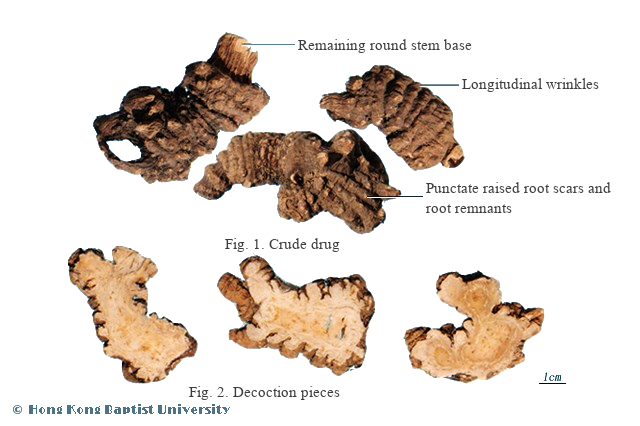
Gao Ben (藁本, Rhizoma Ligustici) is the dried rhizome and root of Ligusticum sinense Oliv. or L. jeholense Nakai et Kitag. (Apiaceae), harvested in autumn when the aerial parts have withered. Like its botanical relatives Chuan Xiong (Ligusticum chuanxiong) and Dang Gui (Angelica sinensis), Gao Ben belongs to the aromatic Apiaceae family and shares their Blood-moving and analgesic properties — but Gao Ben’s clinical niche is distinctly upward, specifically targeting the vertex and occiput (the apex and back of the head). Its acrid-warm nature ascends to the highest point of the body, dispelling Wind-Cold-Damp from the Taiyang (Bladder) and Jueyin (Liver) channels, making it the herb of choice for the classic vertex headache (巅顶头痛) pattern. Li Dongyuan stated: ‘Gao Ben is the indispensable herb for vertex headache — whether from Cold or Dampness, Wind or Heat, it guides other herbs to reach the vertex.’ It is also used for Wind-Damp Bi pain with body aches and cold extremities.
Actions & Therapeutic Effects
- Disperses Wind-Cold and alleviates headache — especially vertex, occipital, and parietal headache from Wind-Cold obstructing the Taiyang and Jueyin channels.
- Dispels Wind-Damp and alleviates Bi pain — treats generalised body aches and joint pain from Wind-Cold-Damp.
- Ascends to the vertex (巅顶) — a rare ‘channel-guiding’ specificity for the Taiyang and Jueyin vertex region.
- Disperses Cold and warms the channels — treats cold extremities and abdominal Cold-pain from Cold obstructing the channels.
Clinical Applications in TCM
- Vertex and occipital headache from Wind-Cold — the premier herb for this specific headache location (巅顶头痛)
- Wind-Cold common cold with headache and body aches — combined with Qiang Huo, Du Huo, and Fang Feng
- Wind-Cold-Damp Bi syndrome with joint pain and cold extremities — paired with Qiang Huo, Fang Feng, and Gui Zhi
- Cervical spondylosis with occipital headache radiating to the vertex — used with Ge Gen and Chuan Xiong
- Chronic sinusitis with headache and purulent discharge — combined with Xin Yi and Cang Er Zi
- Dysmenorrhea from Cold-Damp — paired with Ai Ye and Wu Zhu Yu
- Abdominal pain from Cold and Dampness — combined with Gao Liang Jiang and Gan Jiang
Precautions & Safety
- Dosage: 3–10 g in decoction
- Contraindicated in Yin deficiency with Fire, Blood deficiency with Heat, or Liver Yang rising headache — the warm, ascending nature may aggravate these patterns
- Contraindicated in Wind-Heat headache — the warm, drying character may worsen Heat syndromes
- Caution in patients with hypertension — the ascending action may affect Blood pressure in some patterns
- Use correctly based on headache location: vertex and occipital headaches respond best; frontal headache (Yangming) is better treated with Bai Zhi
Classical TCM Formulas
- Qiang Huo Sheng Shi Tang (羌活胜湿汤): Qiang Huo, Du Huo, Gao Ben, Fang Feng, Chuan Xiong, Man Jing Zi, Zhi Gan Cao — dispels Wind-Damp from the exterior for headache and body aches. Source: Nei Wai Shang Bian Huo Lun.
- Gao Ben San (藁本散): Gao Ben, Bai Zhi, Xi Xin, Chuan Xiong — vertex headache from Wind-Cold. Source: Tai Ping Sheng Hui Fang.
- Shen Zhu Tang (神术汤): Gao Ben, Cang Zhu, Chuan Xiong, Qiang Huo, Bai Zhi, Gan Cao, Sheng Jiang, Cong Bai — headache and body aches from Wind-Cold-Damp. Source: Tai Ping Hui Min He Ji Ju Fang.
- Gao Ben Xi Xin Tang (藁本细辛汤): Gao Ben, Xi Xin, Chuan Xiong, Man Jing Zi — vertex headache from Cold-Damp.
Herb Combinations
- Gao Ben + Qiang Huo (羌活) + Fang Feng (防风): dispels Wind-Cold-Damp for upper body pain and headache — the core triad. Source: Qiang Huo Sheng Shi Tang.
- Gao Ben + Chuan Xiong (川芎) + Bai Zhi (白芷): covers all headache locations — Gao Ben for vertex, Chuan Xiong for any location via Blood-moving, Bai Zhi for frontal.
- Gao Ben + Wu Zhu Yu (吴茱萸): the classic Jueyin vertex headache pair — Gao Ben guides to the vertex, Wu Zhu Yu warms the Liver channel.
- Gao Ben + Ge Gen (葛根) + Gui Zhi (桂枝): releases Taiyang channel for occipital headache and cervical stiffness.
- Gao Ben + Cang Er Zi (苍耳子) + Xin Yi (辛夷): for sinus headache with vertex and frontal involvement.
Pharmacology & Research
Analgesic: ligustilide and ferulic acid demonstrate dose-dependent central and peripheral analgesic activity; significantly reduces formalin-induced pain behaviours.
Anti-inflammatory: ligustilide and other phthalides inhibit COX-2 and NF-κB pathway activation; reduces carrageenan-induced paw edema.
Vasodilatory and antiplatelet: ligustilide relaxes vascular smooth muscle via calcium channel blockade; ferulic acid inhibits platelet aggregation — similar profile to Chuan Xiong.
Antipyretic: volatile oil fraction reduces pyrogen-induced fever in animal models.
Antimicrobial: essential oil demonstrates moderate activity against upper respiratory tract pathogens including Streptococcus pneumoniae.
Classical Descriptions
- 《神农本草经》(Shennong Bencao Jing, circa 200 CE): “藁本,味辛,温。主妇人疝瘕,阴中寒肿痛,腹中急,除风头痛,长肌肤,悦颜色。” (Gao Ben: acrid, warm. Governs female hernial masses; cold swelling and pain in the genital region; acute abdominal pain; eliminates Wind-headache; promotes skin and flesh; brightens the complexion.)
- 《本草纲目》(Bencao Gangmu, 1596) — Li Shizhen: “藁本,乃太阳经风药,其气雄壮,寒气郁于本经头痛,必用之药。” (Gao Ben is a wind-medicinal of the Taiyang channel; its qi is strong and bold — when Cold qi is depressed in this channel causing headache, it is a must-use medicinal.)
- 《珍珠囊》(Zhen Zhu Nang, circa 1200) — Zhang Yuansu: “藁本,乃太阳经风药,治巅顶痛。” (Gao Ben is the wind-medicinal of the Taiyang channel; it treats vertex pain.)
- 《本草备要》(Bencao Beiyao, 1694) — Wang Ang: “藁本,辛温。入膀胱经。治巅顶头痛,连齿颊。祛风散寒,胜湿。” (Gao Ben: acrid-warm. Enters the Bladder channel. Treats vertex headache extending to the teeth and cheeks. Disperses Wind-Cold; overcomes Dampness.)