
Hu Tao Ren 胡桃仁 — Chinese Herbal Medicine
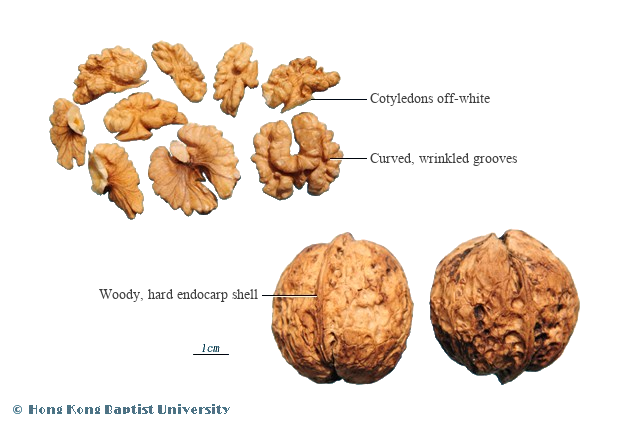
Key Takeaways
- Nature: Warm | Taste: Sweet
- Category: Tonify the KD Yang
- Latin: Semen Juglandis
Hu Tao Ren (胡桃仁) At a Glance
- Herb: Hu Tao Ren
- Chinese name: 胡桃仁 (Hu Tao Ren)
- Latin name: Semen Juglandis
- Nature: Warm
- Taste: Sweet
- Meridian: Lung
- Category: Tonify the KD Yang
Hu Tao Ren, the walnut kernel, has been used medicinally since at least the Tang dynasty, documented by Sun Simiao in the Qian Jin Yi Fang (《千金翼方》) as a warming tonic for the loins and lungs. Its rich, oily, sweet nature gives it a unique ability to simultaneously nourish Kidney Yang and moisten tissues, making it effective across patterns of deficiency-cold and dryness. Clinically it is prized as a gentle yet substantive tonic suited to the elderly and those with chronic Lung-Kidney deficiency presenting with asthma, lumbar weakness, and constipation.
Actions & Therapeutic Effects
- Tonifies Kidney Yang, warms the loins and knees — for Kidney Yang deficiency with lumbar and knee soreness, cold limbs, frequent urination, and impotence.
- Warms the Lungs, assists the Kidneys to grasp Qi, arrests wheezing — for chronic dyspnea and wheezing where Kidney deficiency fails to anchor descending Lung qi; especially effective in cold-pattern asthma and chronic obstructive lung disease.
- Moistens the intestines, unblocks the bowels — for dry, difficult constipation in the elderly or in those with blood and fluid deficiency following illness.
- Warms and consolidates the Kidneys to astringe essence — for spermatorrhea, excessive urination, or urinary incontinence rooted in Kidney Yang deficiency.
Clinical Applications in TCM
- Kidney Yang deficiency with lumbar pain and weak knees: combine with Du Zhong (杜仲), Bu Gu Zhi (补骨脂), and Ba Ji Tian (巴戟天)
- Cold-pattern wheezing with Kidneys failing to grasp Lung qi: pair with Ge Jie (蛤蚧) and Ren Shen (人参), as in Ren Shen Ge Jie San (人参蛤蚧散) modified
- Chronic asthma with cold signs, productive pale sputum: use with Bu Gu Zhi (补骨脂) in the classical Qing E Wan (青蛾丸) pairing
- Elderly dry constipation with deficiency: combine with Huo Ma Ren (火麻仁) and Rou Cong Rong (肉苁蓉)
- Urinary frequency and incontinence from Kidney Yang vacuity: add Yi Zhi Ren (益智仁) and Wu Yao (乌药), modeled on Suo Quan Wan (缩泉丸)
- Impotence or premature ejaculation from Kidney Yang deficiency: combine with Yin Yang Huo (淫羊藿) and Tu Si Zi (菟丝子)
Precautions & Safety
- Dosage 9–30 g in decoction; 1–2 whole kernels daily as food-herb; high oil content is medicinal — avoid prolonged high heat in cooking; can be taken raw, lightly toasted, or as a honey paste
- Contraindicated in Yin deficiency with heat signs, phlegm-heat cough, loose stools or diarrhea, or acute invasion of external pathogens; use cautiously in patients with hyperlipidemia if taken in large quantities over extended periods
Classical TCM Formulas
- Qing E Wan (青娥丸): Hu Tao Ren, Bu Gu Zhi, Du Zhong, Suan Zao Ren — warms Kidney and strengthens lumbar. Source: Tai Ping Hui Min He Ji Ju Fang.
- Hu Tao Ren Zhou (胡桃仁粥): Hu Tao Ren cooked as congee — for chronic dry constipation.
- Hu Tao Ren as single food: 2-3 walnuts daily for brain health and longevity.
Herb Combinations
- Hu Tao Ren (胡桃仁) + Bu Gu Zhi (补骨脂) + Du Zhong (杜仲): the Qing E Wan trio — warms Kidney Yang and strengthens the lumbar for chronic low back pain. Source: Tai Ping Hui Min He Ji Ju Fang.
- Hu Tao Ren (胡桃仁) + Hei Zhi Ma (黑芝麻) + Sang Shen Zi (桑葚子): nourishes Kidney essence and moistens Intestines for chronic dry constipation in the elderly.
- Hu Tao Ren (胡桃仁) + Dang Shen (党参) + Dang Gui (当归): food therapy for post-illness weakness and brain fatigue.
Pharmacology & Research
Lipids: polyunsaturated fatty acids (linoleic, α-linolenic) reduce LDL cholesterol and support vascular endothelial function.
Antioxidant: ellagic acid, juglone, and tocopherols scavenge free radicals and inhibit lipid peroxidation.
Anti-inflammatory: juglone suppresses the NF-κB pathway, reducing pro-inflammatory cytokine expression.
Neuroprotective: omega-3 fatty acids and endogenous melatonin content support cognitive function and attenuate neuroinflammation.
Antitumor: juglone demonstrates cytotoxic activity against multiple cancer cell lines in vitro via apoptosis induction.
Classical Descriptions
- “胡桃仁补气养血,润燥化痰,益命门,利三焦,温肺润肠。” — 《本草纲目》Li Shizhen, 1596
- “治虚寒喘嗽,腰脚重痛,心腹疝痛,血痢肠风。” — 《开宝本草》Ma Zhi, 974