
Hua Shi 滑石 — Chinese Herbal Medicine
Key Takeaways
- Nature: Cold | Taste: Sweet, Bland
- Category: Eliminate urinary tract infection
- Latin: Talcum
Hua Shi (滑石) At a Glance
- Herb: Hua Shi
- Chinese name: 滑石 (Hua Shi)
- Latin name: Talcum
- Nature: Cold
- Taste: Sweet, Bland
- Meridian: Stomach
- Category: Eliminate urinary tract infection
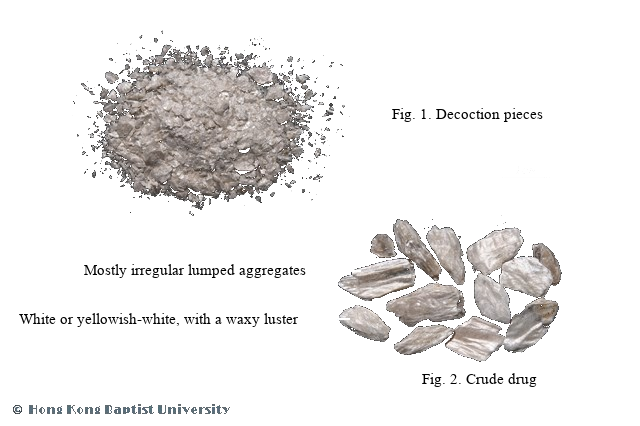
Hua Shi (滑石, Talcum) is the naturally occurring mineral talc, a hydrous magnesium silicate [Mg₃Si₄O₁₀(OH)₂], mined from metamorphic rock deposits and processed into a fine, smooth powder. Its name—’slippery stone’—captures both its physical texture and its clinical quality of smoothing the passage of Damp-Heat out through the urine. Classified among the diuretic herbs that drain Damp-Heat, Hua Shi is a cool, bland, weighty substance that descends through the Bladder channel, opening obstructed urinary pathways, expelling stones, and clearing Summerheat with vexation and thirst. It is applied both internally (as decoction-wrapped powder) and externally (as dusting powder for moist skin lesions). Its unique combination of diuretic and heat-clearing actions makes it the core ingredient in Liu Yi San, one of the most widely used Summerheat formulas in Chinese medicine.
Actions & Therapeutic Effects
- Promotes urination and drains Damp-Heat — primary action; unblocks painful urinary dysfunction (Lin syndrome), especially Heat Lin and Stone Lin with burning, difficult, or obstructed urination.
- Clears Summerheat and quenches thirst — relieves vexation, thirst, and concentrated urine from Summerheat invasion combining with internal Dampness.
- Clears Heat and resolves Dampness — treats Damp-Heat diarrhea, especially in Summerheat season.
- Topical application: absorbs moisture, clears Heat, and protects eroded skin — eczema, prickly heat, and moist skin lesions.
Clinical Applications in TCM
- Heat Lin (热淋) with painful, burning urination — combined with Che Qian Zi, Mu Tong, and Qu Mai in Ba Zheng San
- Stone Lin (石淋) with urinary calculi — paired with Jin Qian Cao, Hai Jin Sha, and Ji Nei Jin (San Jin Pai Shi Tang)
- Summerheat with fever, vexation, and thirst — Liu Yi San (Hua Shi + Gan Cao) is the foundational formula
- Damp-Heat diarrhea with tenesmus — used in combination with Huang Qin and Gan Cao
- Eczema, miliaria (prickly heat), and weeping skin lesions — applied topically as fine dusting powder
- Dysentery from Summerheat and Dampness — combined with Yi Yi Ren and Bai Tou Weng
Precautions & Safety
- Dosage: 10–20 g in decoction (wrapped in cloth to prevent suspension); 6–10 g in pills/powders; external use as needed
- Contraindicated in Spleen qi deficiency without Damp-Heat, or Yin deficiency with internal Heat
- Avoid in pregnancy due to its strong downward-moving, orifice-opening nature
- Long-term or high-dose internal use may deplete fluids — use with caution
- Pharmaceutical-grade talc must be asbestos-free; only use properly sourced medicinal-grade Hua Shi
- External use: avoid inhalation of fine powder dust
Classical TCM Formulas
- Liu Yi San (六一散): Hua Shi (6 parts), Gan Cao (1 part) — clears Summerheat and promotes urination. Source: Shang Han Zhi Ge (Liu Wansu).
- Ba Zheng San (八正散): Che Qian Zi, Qu Mai, Bian Xu, Hua Shi, Shan Zhi Zi, Gan Cao Shao, Mu Tong, Da Huang — clears Heat, drains Fire, and promotes urination for Heat Lin. Source: Tai Ping Hui Min He Ji Ju Fang.
- San Ren Tang (三仁汤): Xing Ren, Bai Dou Kou, Yi Yi Ren, Hua Shi, Tong Cao, Zhu Ye, Hou Po, Ban Xia — diffuses and clears Damp-Warm disorders in the Qi division. Source: Wen Bing Tiao Bian.
- Xiao Ji Yin Zi (小蓟饮子): Xiao Ji, Ou Jie, Pu Huang, Hua Shi, Mu Tong, Dan Zhu Ye, Zhi Zi, Dang Gui, Sheng Di Huang, Gan Cao — cools Blood and stops bleeding in Blood Lin (hematuria with urinary pain). Source: Ji Sheng Fang.
Herb Combinations
- Hua Shi + Gan Cao (甘草) in 6:1 ratio (Liu Yi San): the classic pairing — clears Summerheat and promotes urination. Source: Shang Han Zhi Ge (Liu Wansu).
- Hua Shi + Che Qian Zi (车前子) + Mu Tong (木通): unblocks painful urinary dysfunction — core of Ba Zheng San for Heat Lin. Source: Tai Ping Hui Min He Ji Ju Fang.
- Hua Shi + Jin Qian Cao (金钱草) + Hai Jin Sha (海金沙): the ‘three golds’ — expels urinary calculi and promotes stone passage. Source: Modern clinical combination.
- Hua Shi + Yi Yi Ren (薏苡仁) + Bai Dou Kou (白豆蔻): clears Summerheat-Damp with diarrhoea and abdominal distension, as in San Ren Tang for Damp-Warm disorders.
- Hua Shi + Shi Gao (石膏) for external use: clears Heat, dries Dampness, and protects the skin — an effective approach for acute weeping eczema and summer sores. Source: Topical TCM formulary.
Pharmacology & Research
Adsorbent and protective: forms a protective coating over inflamed gastrointestinal and urinary tract mucosa; reduces water loss in diarrheal conditions by absorbing excess fluid.
Antimicrobial adjunct: the adsorptive surface binds bacterial toxins in the intestinal lumen, aiding clearance in infectious diarrhoea.
Nephroprotective coating effect: the fine, inert particles soothe inflamed urothelium in cystitis and urethritis, reducing dysuria symptoms.
Physical-mechanical diuretic: the high specific gravity and fine particle size increase osmotic pull in the renal tubules, promoting diuresis.
Topical astringent and desiccant: absorbs moisture and reduces friction — effective for intertrigo, miliaria, and weeping dermatoses.
Classical Descriptions
- 《神农本草经》(Shennong Bencao Jing, circa 200 CE): “滑石,味甘,寒。主身热泄澼,女子乳难,癃闭,利小便,蕩胃中积聚寒热,益精气。久服轻身,耐饥长年。” (Hua Shi: sweet, cold. Governs body heat and diarrhoea, difficult lactation in women, urinary obstruction; facilitates urination; sweeps out accumulations of cold and heat in the Stomach; benefits essence and qi. Long-term use lightens the body, resists hunger, and prolongs years.)
- 《本草纲目》(Bencao Gangmu, 1596) — Li Shizhen: “滑石,利窍,渗湿清热。治渴、热痢、淋闭、黄疸、水肿,此皆利窍渗湿之功也。” (Hua Shi opens the orifices, percolates Dampness, and clears Heat. It treats thirst, febrile dysentery, Lin syndromes with urinary obstruction, jaundice, and oedema—all are functions of opening the orifices and percolating Dampness.)
- 《本草备要》(Bencao Beiyao, 1694) — Wang Ang: “滑石,甘淡寒,滑利窍,寒泻热,淡渗湿。故能通利水道,清解暑热。” (Hua Shi: sweet-bland-cold; its slipperiness opens the orifices, its cold drains heat, its blandness percolates dampness. Therefore, it can unblock the waterways and clear Summerheat.)