
Jiang Xiang 降香 — Chinese Herbal Medicine
Key Takeaways
- Nature: Warm | Taste: Acrid
- Category: Promote blood circulation and stop bleeding
- Latin: Lignum Dalbergiae Odoriferae
Jiang Xiang (降香) At a Glance
- Herb: Jiang Xiang
- Chinese name: 降香 (Jiang Xiang)
- Latin name: Lignum Dalbergiae Odoriferae
- Nature: Warm
- Taste: Acrid
- Meridian: Heart
- Category: Promote blood circulation and stop bleeding
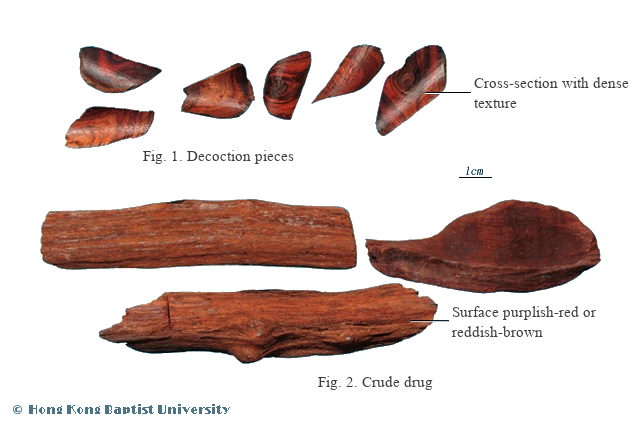
Jiang Xiang (降香) is the fragrant heartwood of Dalbergia odorifera, a Leguminosae tree indigenous to Hainan and southern China. Its warm, acrid nature allows it to enter the Heart and Liver channels, dispersing qi and blood stagnation to relieve chest and epigastric pain while simultaneously arresting bleeding from trauma. Valued in Chinese medicine since the Tang dynasty, it occupies a unique position as an herb that both moves blood and stops bleeding without excessive dispersing action.
Actions & Therapeutic Effects
- Promotes blood circulation and relieves pain — for chest bi syndrome and epigastric pain due to qi and blood stasis
- Descends rebellious qi and harmonises the stomach — for nausea and vomiting caused by counterflow qi
- Stops bleeding and transforms stasis — particularly for traumatic wounds where stasis and bleeding coexist
- Warms the channels and disperses cold — for cold-type stagnation patterns in the chest and abdomen
Clinical Applications in TCM
- Chest bi (angina-type) pain: combine with Dan Shen (Salvia miltiorrhiza), Chuan Xiong (Ligusticum chuanxiong), and Bai Tan Xiang (Santalum album) to unblock the Heart channel and relieve stasis pain
- Epigastric and abdominal pain from cold stagnation: pair with Wu Yao (Lindera aggregata), Xiang Fu (Cyperus rotundus), and Yan Hu Suo (Corydalis yanhusuo)
- Traumatic bleeding with underlying stasis: apply powdered Jiang Xiang topically, or combine internally with San Qi (Panax notoginseng) and Xue Jie (Draconis Resina)
- Nausea and vomiting from rebellious stomach qi: combine with Ding Xiang (Syzygium aromaticum), Chen Pi (Citrus reticulata), and Ban Xia (Pinellia ternata)
- Post-traumatic pain and swelling: use with Ru Xiang (Boswellia carterii), Mo Yao (Commiphora myrrha), and Hong Hua (Carthamus tinctorius)
Precautions & Safety
- Standard decoction dose: 3–6 g; when powdered and swallowed with warm water, reduce to 1–2 g per dose
- Contraindicated in blood deficiency without stasis and in heat-pattern bleeding where warming herbs would aggravate the condition
- Use with caution during pregnancy; blood-moving action may be inappropriate in the first trimester
- Not suitable for yin deficiency with ascending fire
Classical TCM Formulas
- Qi Li San (七厘散): Xue Jie, Ru Xiang, Mo Yao, Hong Hua, Er Cha, Bing Pian, Jiang Xiang, She Xiang — traumatic injury with bleeding and pain. Source: Liang Fang Ji Ye.
- Dan Shen Di Wan (丹参滴丸) includes Jiang Xiang in some formulations — for angina.
- Jiang Xiang San (降香散): Jiang Xiang single herb — for Blood stasis pain.
Herb Combinations
- Jiang Xiang (降香) + San Qi (三七) + Pu Huang (蒲黄): stops bleeding and dispels Blood stasis for traumatic injury with ecchymosis and pain.
- Jiang Xiang (降香) + Dan Shen (丹参) + Yu Jin (郁金): activates Blood and stops pain for angina from Blood stasis.
- Jiang Xiang (降香) + Ru Xiang (乳香) + Mo Yao (没药): activates Blood and stops pain for traumatic injuries.
Pharmacology & Research
Cardiovascular: flavonoids and pterocarpans (including formononetin) inhibit platelet aggregation and exhibit vasodilatory effects, supporting traditional use in chest bi syndrome.
Haemostatic: promotes local platelet activation at wound sites while avoiding systemic hypercoagulation, consistent with the classical “stops bleeding without retaining stasis” characterisation.
Anti-inflammatory: volatile oil fractions inhibit prostaglandin and leukotriene synthesis, reducing inflammatory pain in soft-tissue injury models.
Antimicrobial: essential oils demonstrate activity against gram-positive pathogens including Staphylococcus aureus, relevant to its topical wound applications.
Classical Descriptions
- “降香,辛,溫,無毒。行氣破血,止血定痛,治金瘡出血,吐血咳血。” — 本草綱目 (Bencao Gangmu), Li Shizhen, 1578