
Lian Zi Xin 莲子心 — Chinese Herbal Medicine
Key Takeaways
- Nature: Cold | Taste: Bitter
- Category: Stop Diarrhea astringent essence
- Latin: Plumula Nelumbinis
Lian Zi Xin (莲子心) At a Glance
- Herb: Lian Zi Xin
- Chinese name: 莲子心 (Lian Zi Xin)
- Latin name: Plumula Nelumbinis
- Nature: Cold
- Taste: Bitter
- Meridian: Pericardium
- Category: Stop Diarrhea astringent essence
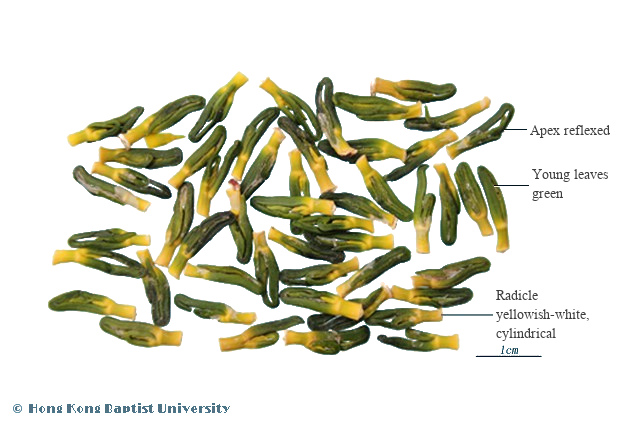
Lian Zi Xin (莲子心, Plumula Nelumbinis) is the green embryo extracted from the ripe seed of *Nelumbo nucifera* Gaertn. (Nymphaeaceae). Harvested at seed maturity, the tiny plumule is separated and sun-dried. Its intense bitterness drives it directly into the Heart and Pericardium, where it clears blazing fire, quiets a spirit disturbed by heat, cools reckless blood, and re-establishes communication between Heart and Kidney. It is one of the sharpest cooling agents available for excess-heat patterns affecting the upper Jiao. Note that Lian Zi Xin is categorically distinct from Lian Zi (the whole lotus seed): Lian Zi is warm and astringent; Lian Zi Xin is cold and dispersing — opposite thermal profiles from the same fruit.
Actions & Therapeutic Effects
- Clears Heart fire and drains Pericardium heat
- Calms the spirit and relieves agitation
- Cools blood and arrests bleeding
- Reconnects Heart and Kidney (交通心肾)
Clinical Applications in TCM
- **Heart fire blazing**: Palpitations, severe insomnia, restless agitation (烦躁不安), mouth and tongue ulcers, thirst with craving for cold drinks — combine with Huang Lian and Zhu Ye.
- **Warm disease with heat entering the Pericardium**: High sustained fever, delirium, incoherent speech — classically used in Qing Gong Tang (清宫汤) with Dan Zhu Ye, Sheng Di Huang, and Xuan Shen.
- **Heart-Kidney disharmony**: Insomnia, nocturnal emissions where Heart fire fails to descend and Kidney water fails to ascend — combine with Huang Lian and Rou Gui following the Jiao Tai Wan (交泰丸) principle.
- **Blood-heat hemorrhage**: Hematemesis, epistaxis, or hematuria from heat forcing blood out of the vessels — combine with Bai Mao Gen and Sheng Di Huang.
Precautions & Safety
- Contraindicated in cold-deficiency patterns: abdominal cold pain or loose stools from Spleen-Yang deficiency.
- Use cautiously during pregnancy; strong downward-draining action on fire, with limited human safety data.
- Prolonged use may injure Stomach Qi — pair with neutral harmonizing herbs in extended protocols.
- Distinguish clearly from Lian Zi (莲子): clinical error is common due to shared naming; Lian Zi warms and astringes, Lian Zi Xin clears and disperses.
Classical TCM Formulas
- Qing Gong Tang (清宫汤): Xuan Shen, Lian Zi Xin, Zhu Ye, Lian Qiao, Xi Jiao, Mai Men Dong — clears Pericardium Heat for late-stage warm-febrile disease. Source: Wen Bing Tiao Bian.
- Lian Zi Xin Cha (莲子心茶): Lian Zi Xin steeped as tea — for irritability, insomnia, palpitations, and bitter taste in the mouth from Heart Fire.
- Modified Jiao Tai Wan (交泰丸): Huang Lian, Rou Gui + Lian Zi Xin — Heart-Kidney disharmony with Fire flaring upward.
Herb Combinations
- Lian Zi Xin (莲子心) + Huang Lian (黄连) + Zhi Zi (栀子): the bitter trio for severe Heart Fire — Lian Zi Xin clears Pericardium, Huang Lian clears Heart, Zhi Zi drains San Jiao. Source: Classical Heart-Fire formulas.
- Lian Zi Xin (莲子心) + Xuan Shen (玄参) + Mai Men Dong (麦门冬): clears Heart Fire while nourishing Yin for Yin deficiency with ascending Fire.
- Lian Zi Xin (莲子心) + Suan Zao Ren (酸枣仁) + Dan Shen (丹参): clears Heart Fire and calms the spirit for insomnia with agitation.
- Lian Zi Xin (莲子心) + Lian Zi (莲子): the complementary whole-plant pair — Lian Zi Xin clears Fire from the Heart, Lian Zi tonifies and astringes the Kidney.
Pharmacology & Research
**Active constituents**: Bisbenzylisoquinoline alkaloids — liensinine (莲心碱), isoliensinine, neferine (甲基莲心碱), nuciferine; also methylcorypalline and flavonoid glycosides.
**Pharmacological actions**:
– **Cardiovascular**: Neferine and liensinine exert antihypertensive effects via calcium-channel antagonism and ACE inhibition; antiarrhythmic activity confirmed in multiple animal models.
– **CNS / Sedative**: Alkaloid fraction suppresses spontaneous motor activity and potentiates pentobarbital sleep time in rodent studies, directly supporting the classical calming-spirit indication.
– **Anti-inflammatory / Antioxidant**: Flavonoid fraction scavenges free radicals and inhibits pro-inflammatory cytokines (IL-6, TNF-α) in cell and animal models.
– **Hemostatic**: Aqueous extract shortens bleeding time in animal models, consistent with the classical blood-cooling hemostatic action.
– **Antidiabetic**: Preliminary evidence suggests neferine improves insulin sensitivity and reduces fasting glucose in diabetic rodent models.
**Standard dosage**: 1.5–3 g in decoction; frequently steeped as tea. Add toward the end of decoction to preserve volatile alkaloids.
Classical Descriptions
- **Ben Cao Gang Mu (本草纲目, 1596)** — Li Shizhen: “The heart of the lotus seed is extremely bitter; it clears the fire of the Heart, calms the spirit, and stops thirst.”
- **Wen Bing Tiao Bian (温病条辨, 1798)** — Wu Jutong deploys Lian Zi Xin in Qing Gong Tang to clear residual Pericardium heat and rescue the spirit in late-stage warm-febrile disease.
- **Ben Cao Bei Yao (本草备要, 1694)** — Wang Ang: “It clears Heart fire, drains heat from the Pericardium, and stops thirst arising from fire.”
- **Sui Xi Ju Yin Shi Pu (随息居饮食谱, 1861)** — Wang Mengying recommends Lian Zi Xin steeped as tea for summerheat with irritability, palpitations, and insomnia.