
Ling Xiao Hua 凌霄花 — Chinese Herbal Medicine
Key Takeaways
- Nature: Cool | Taste: Sweet, Acid
- Category: Promotes blood circulation and relieves pain
- Latin: Flos Campsis
Ling Xiao Hua (凌霄花) At a Glance
- Herb: Ling Xiao Hua
- Chinese name: 凌霄花 (Ling Xiao Hua)
- Latin name: Flos Campsis
- Nature: Cool
- Taste: Sweet, Acid
- Meridian: Pericardium
- Category: Promotes blood circulation and relieves pain
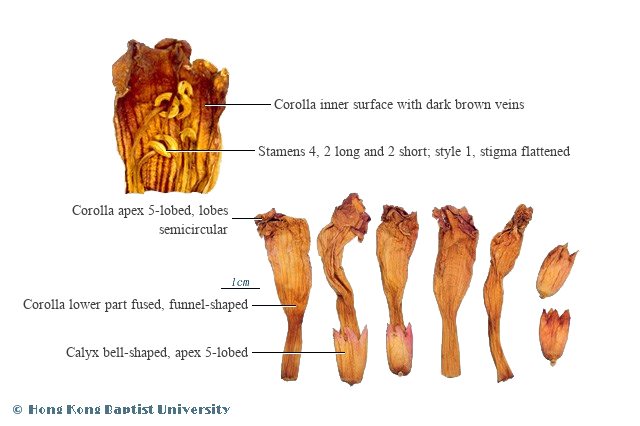
Ling Xiao Hua (凌霄花, Flos Campsis) is the dried flower of Campsis grandiflora (Thunb.) K. Schum. (Bignoniaceae), a vigorous deciduous climbing vine native to China and widely cultivated as an ornamental. Its romantic name — ‘flower that pierces the heavens’ — describes both its climbing habit and, metaphorically, its ability to ascend to and treat the upper body while also breaking through stubborn Blood stasis in the gynecological system. Harvested in summer during full bloom, the trumpet-shaped orange-red flowers are dried whole. Ling Xiao Hua is prized in gynecology for its ability to break Blood stasis and unblock the menses, while its cool nature distinguishes it from purely warming Blood movers — making it appropriate when Blood stasis coexists with Heat signs. It also dispels Wind from the skin, treating pruritic dermatoses.
Actions & Therapeutic Effects
- Invigorates Blood and unblocks menses — breaks Blood stasis and regulates menstruation; treats amenorrhea and dysmenorrhea from blood stasis, especially with Heat signs.
- Cools Blood and dispels Wind — treats skin disorders with redness, itching, and eruptions from Blood-Heat generating Wind.
- Disperses masses and reduces concretions (消癥散结) — treats abdominal masses, uterine fibroids, and ovarian cysts from Blood stasis.
- Dispels Wind and relieves itching — specifically for Wind-Heat and Blood-Heat pruritic skin conditions recalcitrant to conventional treatment.
Clinical Applications in TCM
- Amenorrhea and dysmenorrhea from Blood stasis — combined with Dang Gui, Hong Hua, and Chi Shao
- Uterine fibroids and ovarian cysts — paired with E Zhu, San Leng, and Dan Shen
- Urticaria (hives) and pruritus from Blood-Heat with Wind — used with Di Fu Zi, Bai Xian Pi, and Chan Tui
- Eczema with redness and itching from Wind-Heat in the Blood — combined with Ku Shen and Fang Feng
- Severe acne with inflamed, purplish-red lesions — paired with Mu Dan Pi, Sheng Di Huang, and Jin Yin Hua
- Postpartum lochia retention with abdominal pain — combined with Yi Mu Cao and Shan Zha
- Rosacea (酒糟鼻) from Blood-Heat — used externally as a facial wash
Precautions & Safety
- Dosage: 3–10 g in decoction; 1.5–3 g as powder
- Contraindicated in pregnancy — Blood-breaking and menses-unblocking action may cause miscarriage
- Contraindicated in Qi and Blood deficiency without stasis
- Caution in Spleen deficiency with loose stools — cold nature may worsen diarrhea
- Avoid in patients with bleeding disorders or thrombocytopenia
- May cause mild nausea in sensitive patients — take after meals
- Pollen from fresh flowers may provoke allergic reactions in sensitive individuals
Classical TCM Formulas
- Ling Xiao Hua San (凌霄花散): Ling Xiao Hua, Dang Gui, Hong Hua, Mo Yao, Yan Hu Suo, Gui Zhi, Gan Jiang — invigorates Blood and unblocks menses for amenorrhea with abdominal pain. Source: Tai Ping Sheng Hui Fang.
- Modified Xiao Feng San (消风散) + Ling Xiao Hua: Jing Jie, Fang Feng, Niu Bang Zi, Chan Tui, Ku Shen, Cang Zhu, Shi Gao, Sheng Di Huang, Dang Gui, Zhi Mu, Tong Cao + Ling Xiao Hua — dispels Wind, clears Heat, and cools Blood for acute urticaria and eczema.
- Ling Xiao Hua Tang (凌霄花汤): Ling Xiao Hua, Mu Dan Pi, Sheng Di Huang, Jin Yin Hua, Gan Cao — Blood-Heat skin eruptions with redness and itching.
Herb Combinations
- Ling Xiao Hua + Dang Gui (当归) + Hong Hua (红花): invigorates Blood and unblocks menses for amenorrhea from Blood stasis. Source: Classical Blood-invigorating combinations.
- Ling Xiao Hua + E Zhu (莪术) + San Leng (三棱): breaks Blood stasis and disperses masses for uterine fibroids. Source: Gynecological stasis-mass formulas.
- Ling Xiao Hua + Bai Xian Pi (白鲜皮) + Di Fu Zi (地肤子): cools Blood, dispels Wind, and stops itching for urticaria and eczema from Blood-Heat. Source: Dermatological anti-pruritic combinations.
- Ling Xiao Hua + Mu Dan Pi (牡丹皮) + Sheng Di Huang (生地黄): clears Heat and cools Blood for acne and rosacea. Source: Blood-cooling dermatological formulas.
- Ling Xiao Hua + Yi Mu Cao (益母草): strengthens the Blood-moving and menses-regulating effect; classic pair for postpartum Blood stasis patterns.
Pharmacology & Research
Anti-inflammatory: acteoside (verbascoside) and other phenylethanoid glycosides inhibit COX-2 and suppress NF-κB pathway activation; reduces carrageenan-induced paw edema.
Uterine stimulant: low concentrations induce rhythmic contractions; high concentrations produce tonic contraction — clinically relevant for both emmenagogue action and pregnancy contraindication.
Antipruritic: reduces histamine-induced itching in experimental models; mechanism involves stabilisation of mast cell membranes.
Vasodilatory: flavonoids relax pre-contracted vascular smooth muscle via NO-cGMP pathway.
Antioxidant: phenylethanoid glycosides (acteoside, isoacteoside) demonstrate potent DPPH and superoxide radical scavenging.
Antimicrobial: flower extracts show moderate activity against Propionibacterium acnes and Staphylococcus epidermidis — supports traditional use in acne and skin infections.
Classical Descriptions
- 《神农本草经》(Shennong Bencao Jing, circa 200 CE): “凌霄花,味酸,微寒。主妇人产乳余疾,崩中,症瘕,血闭,寒热,羸瘦,养胎。” (Ling Xiao Hua: sour, slightly cold. Governs residual postpartum and lactation disorders in women, flooding and spotting, concretions and gatherings, blood stasis obstruction, cold-heat conditions, emaciation; it nourishes the fetus.)
- 《本草纲目》(Bencao Gangmu, 1596) — Li Shizhen: “凌霄花及根,甘酸而寒,茎叶带苦。手足厥阴经药也。行血分,能去血中伏火。故主妇人产乳余疾,及诸血热血闭之证。” (Ling Xiao Hua and root: sweet-sour and cold; the stem and leaf carry bitterness. It is a medicinal for the hand and foot Jueyin channels [Pericardium and Liver]. It moves in the Blood division and can eliminate latent Fire within the Blood. Therefore, it governs women’s residual postpartum and lactation diseases and various patterns of Blood-Heat with Blood obstruction.)
- 《本草备要》(Bencao Beiyao, 1694) — Wang Ang: “凌霄花,甘酸性寒,入肝、心包血分。破瘀通经,凉血祛风。” (Ling Xiao Hua: sweet-sour, cold nature; enters the Blood division of Liver and Pericardium. Breaks stasis and unblocks menses; cools Blood and dispels Wind.)