
Meng Chong 虻虫 — Chinese Herbal Medicine
Key Takeaways
- Nature: Cool | Taste: Bitter
- Category: Promotes blood circulation and eliminates masses
- Latin: Tabanus bivittatus Matsumura
Meng Chong (虻虫) At a Glance
- Herb: Meng Chong
- Chinese name: 虻虫 (Meng Chong)
- Latin name: Tabanus bivittatus Matsumura
- Nature: Cool
- Taste: Bitter
- Meridian: Liver
- Category: Promotes blood circulation and eliminates masses
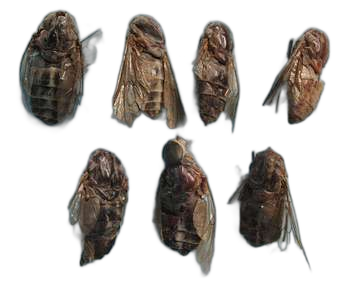
Meng Chong is the dried body of the female horse-fly (gadfly) and ranks among the most forceful blood-moving agents in the Chinese materia medica. Its bitter, cool nature drives directly into the Liver channel, breaking up long-standing congealed blood that milder medicinals cannot reach. Classical texts consistently place it alongside Shui Zhi as one of the paired “insect medicines” for resolving tenacious blood accumulation.
Actions & Therapeutic Effects
- Breaks blood stasis and eliminates hard masses
- Unblocks the menses and dispels amenorrhoea due to blood obstruction
- Disperses abdominal accumulations and palpable concretions
- Clears heat in the blood aspect while moving congealed blood
Clinical Applications in TCM
- Severe blood stasis with lower abdominal hardness and tenderness: combine with Shui Zhi, Da Huang, and Tao Ren (Di Dang Tang)
- Amenorrhoea or postpartum lochia retention from blood stasis: use with Tao Ren, Da Huang, and Mang Xiao
- Abdominal masses and concretions (zheng jia): combine with Bie Jia, Da Huang, and Zhe Chong (Da Huang Zhe Chong Wan)
- Blood stasis with internal heat, dry skin, and emaciation: integrate into Zhe Chong formulas targeting chronic deficiency-stasis patterns
- Traumatic injury with severe bruising and swelling: combine with Ru Xiang, Mo Yao, and Su Mu
Precautions & Safety
- Dosage: 1–1.5 g in decoction; 0.3 g when ground into powder or pill form; use the minimum effective dose
- Contraindicated in pregnancy — potent uterine stimulant and teratogenic risk
- Contraindicated where there is qi and blood deficiency without true stasis
- Avoid in patients with bleeding disorders or on anticoagulant therapy
- Not suitable for prolonged use; re-assess after each treatment course
Classical TCM Formulas
- Di Dang Tang (抵当汤): Shui Zhi, Meng Chong, Tao Ren, Da Huang — severe Blood stasis in the lower abdomen. Source: Shang Han Lun.
- Di Dang Wan (抵当丸): the same herbs in pill form for milder but chronic Blood stasis. Source: Shang Han Lun.
- Meng Chong is a classical Blood-stasis-breaking insect of primarily historical/specialist modern use.
Herb Combinations
- Meng Chong (虻虫) + Shui Zhi (水蛭) + Di Bie Chong (地鳖虫): the three insect Blood-breakers — the strongest combination for severe, recalcitrant Blood stasis.
- Meng Chong (虻虫) + Da Huang (大黄) + Tao Ren (桃仁): from Di Dang Tang — attacks Blood stasis for lower abdominal masses. Source: Shang Han Lun.
- Meng Chong is extremely potent and reserved for severe Blood stasis where gentler herbs have failed.
Pharmacology & Research
Anticoagulant: salivary thrombin inhibitors reduce platelet aggregation and prolong clotting time.
Fibrinolytic: active fractions promote plasminogen activation, dissolving existing thrombi.
Anti-inflammatory: histamine-pathway modulation reduces local oedema in blood-stasis models.
Uterine stimulant: isolated compounds increase uterine contractility in animal studies, consistent with the classical contraindication in pregnancy.
Classical Descriptions
- “Meng Chong: flavour bitter, slightly cold. Governs the breaking of accumulations of blood, jiǎ jù (concretions and gatherings), and cold heat. Breaks hardness, dispels blood, and unblocks the channels.” — *Shen Nong Ben Cao Jing* (神农本草经), c. 1st century CE