
Sheng Ma 升麻 — Chinese Herbal Medicine
Key Takeaways
- Nature: Cool | Taste: Acrid, Sweet
- Category: Cool and pungent exterior-releasing
- Latin: Rhizoma Cimicifugae
Sheng Ma (升麻) At a Glance
- Herb: Sheng Ma
- Chinese name: 升麻 (Sheng Ma)
- Latin name: Rhizoma Cimicifugae
- Nature: Cool
- Taste: Acrid, Sweet
- Meridian: Lung
- Category: Cool and pungent exterior-releasing
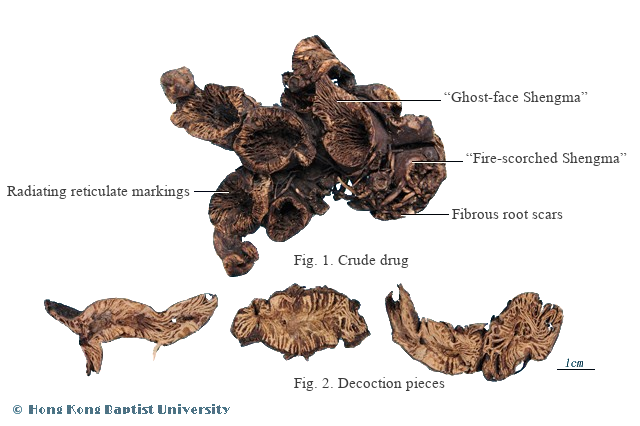
Sheng Ma (升麻, Rhizoma Cimicifugae) is the dried rhizome of Cimicifuga foetida L., C. dahurica (Turcz.) Maxim., or C. heracleifolia Kom. (Ranunculaceae), harvested in autumn when the aerial parts have withered. Its name — ‘ascending hemp’ — describes its defining clinical action: raising the clear Yang upward, like a plant that ascends toward the sky. Sheng Ma is one of the few herbs that simultaneously releases exterior Wind-Heat patterns and lifts sunken Spleen Qi, making it indispensable in two major formula categories. Li Dongyuan (李东垣), the great Spleen-Stomach school master, made Sheng Ma a key component of his famous Bu Zhong Yi Qi Tang, where a small dose of this light, ascending herb leverages the heavy tonic herbs upward to restore the physiological ascent of clear Yang. Its additional ability to clear Heat and resolve toxicity makes it the sovereign herb in formulas for measles with incomplete eruption and Yangming channel Heat-toxin patterns.
Actions & Therapeutic Effects
- Releases exterior Wind-Heat — treats early-stage externally-contracted Wind-Heat with fever, headache, and sore throat.
- Raises sunken Yang Qi (升阳举陷) — the signature action; lifts prolapse of the rectum, uterus, or Stomach from chronic Spleen Qi sinking.
- Clears Heat-toxin and vents rashes — promotes full expression of eruptive diseases (measles, scarlet fever) while clearing the underlying Heat-toxin.
- Raises clear Yang to the head and orifices — treats headache and dizziness from clear Qi failing to ascend.
- Acts as a messenger (使药) — guides the formula’s action upward, especially in Spleen-tonifying formulas.
Clinical Applications in TCM
- Spleen Qi sinking with chronic diarrhea, rectal prolapse, or uterine prolapse — Bu Zhong Yi Qi Tang (Sheng Ma + Chai Hu as the raising pair)
- Early-stage measles with incomplete eruption — Sheng Ma Ge Gen Tang promotes full expression while preventing inward sinking of the pathogenic factor
- Stomach Heat with gingivitis, toothache, and oral ulcers — Qing Wei San uses Sheng Ma to both clear Heat and guide the formula to the Stomach channel
- Yangming headache (frontal headache) from Wind-Heat — combined with Bai Zhi and Shi Gao
- Acute pharyngitis and tonsillitis from Wind-Heat — paired with Jie Geng and Gan Cao
- Postpartum fever and vexation — used in Sheng Ma San with Chai Hu and Gan Cao
- Uterine bleeding from Qi deficiency failing to contain Blood — Bu Zhong Yi Qi Tang modification
Precautions & Safety
- Dosage: 3–10 g for exterior-releasing and rash-venting; 1.5–3 g for raising Yang (small dose is key — large doses may cause upward-rebellious Qi)
- Contraindicated in Yin deficiency with Yang hyperactivity, Liver Yang rising, or upward-blazing Fire
- Contraindicated in full measles eruption — once the rash has fully expressed, the venting action becomes counterproductive
- Caution in patients with hypertension — the ascending action may theoretically raise Blood pressure in some patterns
- Overdose may cause dizziness, nausea, and vomiting — the classic sign of excessive upward-raising effect
- In the raising Yang role, always pair with Chai Hu or a similar descending-moderating herb
Classical TCM Formulas
- Bu Zhong Yi Qi Tang (补中益气汤): Huang Qi, Ren Shen, Bai Zhu, Zhi Gan Cao, Dang Gui, Chen Pi, Sheng Ma, Chai Hu — supplements the centre and raises Yang for Spleen Qi sinking. Source: Pi Wei Lun (Li Dongyuan).
- Sheng Ma Ge Gen Tang (升麻葛根汤): Sheng Ma, Ge Gen, Bai Shao, Gan Cao — vents rashes and releases the exterior for measles with incomplete expression. Source: Xiao Er Yao Zheng Zhi Jue.
- Qing Wei San (清胃散): Sheng Ma, Huang Lian, Sheng Di Huang, Dang Gui, Mu Dan Pi — clears Stomach Fire for gingivitis and toothache. Source: Lan Shi Mi Cang.
- Zi Xue Dan (紫雪丹) with Sheng Ma: Shi Gao, Han Shui Shi, Hua Shi, Ci Shi, Xuan Shen, Sheng Ma, Gan Cao, Ling Yang Jiao, Xi Jiao, Chen Xiang, Ding Xiang, Mu Xiang — clears Heat, opens the orifices, and arrests convulsions. Source: Tai Ping Hui Min He Ji Ju Fang.
Herb Combinations
- Sheng Ma + Chai Hu (柴胡): the classic Yang-raising pair — Chai Hu raises Liver Qi, Sheng Ma raises Spleen-Stomach Qi; together they restore the ascent of clear Yang. Source: Bu Zhong Yi Qi Tang (Pi Wei Lun).
- Sheng Ma + Ge Gen (葛根): vents rashes and releases the exterior — core of Sheng Ma Ge Gen Tang for measles with incomplete eruption. Source: Xiao Er Yao Zheng Zhi Jue.
- Sheng Ma + Huang Lian (黄连) + Sheng Di Huang (生地黄): clears Stomach Fire for gingivitis, toothache, and oral ulcers. Source: Qing Wei San (Lan Shi Mi Cang).
- Sheng Ma + Bai Zhi (白芷) + Shi Gao (石膏): clears Yangming channel Heat for frontal headache and supraorbital pain. Source: Classical Yangming headache formulas.
- Sheng Ma + Jie Geng (桔梗): dual raising and opening combination — opens the Lung and raises clear Qi for throat disorders and sinking patterns simultaneously.
Pharmacology & Research
Antipyretic and anti-inflammatory: cimicifugoside and isoferulic acid reduce PGE2 production and suppress pyrogen-induced fever comparable to standard NSAIDs.
Phytoestrogenic: actein and cimifugin demonstrate selective estrogen receptor modulation (SERM-like activity) — clinically relevant for menopausal symptoms and the herb’s traditional use in gynecological patterns.
Hepatoprotective: isoferulic acid and caffeic acid derivatives reduce chemical-induced hepatotoxicity by enhancing glutathione synthesis and phase II detoxification.
Bone-protective: cimicifugoside inhibits RANKL-induced osteoclastogenesis, supporting the traditional ‘raising and securing’ action in prolapse patterns with underlying bone loss.
Analgesic: cimifugin exhibits formalin-test analgesic activity; peripheral rather than central mechanism.
Antiviral: ferulic acid and phenolic glycosides inhibit influenza A virus neuraminidase in vitro.
Classical Descriptions
- 《神农本草经》(Shennong Bencao Jing, circa 200 CE): “升麻,味甘辛,平。主解百毒,杀百精老物殃鬼,辟瘟疫瘴气邪气,蛊毒入口皆吐出,中恶腹痛,时气毒疠,头痛寒热,风肿诸毒,喉痛口疮。” (Sheng Ma: sweet-acrid, balanced. Governs resolving the hundred toxins, kills the hundred essences and old spectral influences; wards off pestilence, miasmic qi, and pathogenic qi; gu toxins entering the mouth are all expelled by vomiting; treats malign strike with abdominal pain, seasonal toxic epidemics, headache with chills and fever, wind swelling and various toxins, throat pain and oral sores.)
- 《本草纲目》(Bencao Gangmu, 1596) — Li Shizhen: “升麻,引阳明清气上行,此乃禀赋素弱,元气虚馁,及劳役饥饱,生冷内伤,脾胃引经最要药也。” (Sheng Ma guides clear Yang qi of the Yangming upward; for those of constitutionally weak endowment with vacuity of original qi, and for damage from taxation, hunger, and raw-cold internal injury, it is the most essential channel-guiding medicinal for the Spleen and Stomach.)
- 《本草备要》(Bencao Beiyao, 1694) — Wang Ang: “升麻,甘苦辛凉,入肺脾胃大肠。升阳发表,解毒透疹,引经上行。” (Sheng Ma: sweet-bitter-acrid, cool; enters Lung, Spleen, Stomach, and Large Intestine. Raises Yang and releases the exterior; resolves toxicity and vents rashes; guides the channel upward.)