
Wan Jing Zi 蔓荆子 — Chinese Herbal Medicine
Key Takeaways
- Nature: Cool | Taste: Acrid, Bitter
- Category: Cool and pungent exterior-releasing
- Latin: Fructus Viticis
Wan Jing Zi (蔓荆子) At a Glance
- Herb: Wan Jing Zi
- Chinese name: 蔓荆子 (Wan Jing Zi)
- Latin name: Fructus Viticis
- Nature: Cool
- Taste: Acrid, Bitter
- Meridian: Liver
- Category: Cool and pungent exterior-releasing
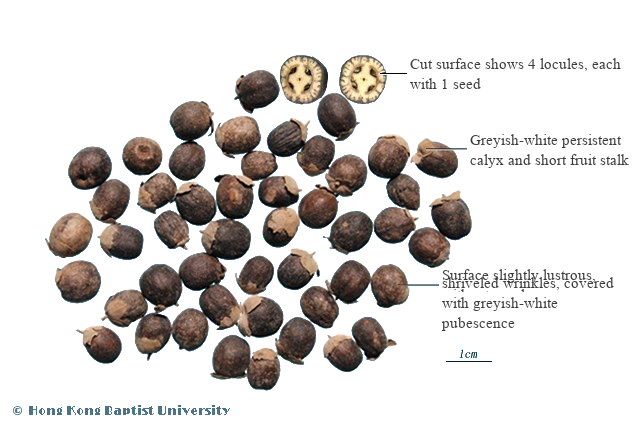
Wan Jing Zi (蔓荆子, Fructus Viticis) is the dried ripe fruit of Vitex trifolia L. var. simplicifolia Cham. or V. trifolia L. (Lamiaceae/Verbenaceae), a sprawling coastal shrub that grows across East and Southeast Asia. The tiny, aromatic, grey-brown fruits — resembling miniature peppercorns — are harvested in autumn when ripe. The name ‘creeping-thorn seed’ describes the plant’s low, spreading growth habit. Wan Jing Zi is among the lightest, most ascending of the exterior-releasing herbs: its acrid-bitter cool nature rises specifically to the head and eyes, dispersing Wind-Heat from the upper orifices. It is the sovereign herb for Wind-Heat headache with visual disturbance — blurred vision, photophobia, and excess tearing — and its lightweight quality allows it to reach the very top of the body, treating vertex and temporal headache that other exterior-releasing herbs cannot reach.
Actions & Therapeutic Effects
- Disperses Wind-Heat and clears the head — the premier herb for Wind-Heat headache with a sensation of ‘heaviness’ or distension of the head.
- Brightens the eyes — treats blurred vision, photophobia, and excessive tearing from Wind-Heat rising to the eyes.
- Disperses Wind and alleviates pain — treats Wind-pattern headache, toothache, and facial pain.
- Releases the exterior — mild exterior-releasing action for Wind-Heat exterior syndrome with headache as the primary complaint.
Clinical Applications in TCM
- Wind-Heat headache with heavy sensation and distension of the head — Wan Jing Zi is the sovereign herb
- Temporal and vertex headache from Wind-Heat — combined with Chuan Xiong, Bai Zhi, and Bo He
- Blurred vision, photophobia, and tearing from Wind-Heat — paired with Ju Hua and Chan Tui
- Toothache from Wind-Heat rising — used with Shi Gao and Bai Zhi
- Acute conjunctivitis from Wind-Heat — combined with Ju Hua, Sang Ye, and Xia Ku Cao
- Tension-type headache with neck stiffness — paired with Ge Gen and Chuan Xiong
Precautions & Safety
- Dosage: 5–10 g in decoction; crush before decocting to release the volatile oils
- Contraindicated in Blood deficiency headache (dull, chronic headache with pale complexion) — the light, dispersing nature may deplete
- Contraindicated in Stomach Cold or Spleen deficiency with loose stools — the cool nature may worsen
- The fruit should be lightly crushed before use to expose the seeds and volatile compounds
- Generally well-tolerated in appropriate patterns
Classical TCM Formulas
- Wan Jing Zi San (蔓荆子散): Wan Jing Zi, Sheng Di Huang, Chi Shao, Gan Cao, Mai Men Dong, Sang Bai Pi, Jie Geng — disperses Wind-Heat and clears the head. Source: Tai Ping Sheng Hui Fang.
- Qiang Huo Sheng Shi Tang (羌活胜湿汤) includes Wan Jing Zi: Qiang Huo, Du Huo, Gao Ben, Fang Feng, Chuan Xiong, Wan Jing Zi, Zhi Gan Cao — dispels Wind-Damp from the exterior. Source: Nei Wai Shang Bian Huo Lun.
- Yi Qi Cong Ming Tang (益气聪明汤): Huang Qi, Ren Shen, Sheng Ma, Ge Gen, Wan Jing Zi, Bai Shao, Huang Bai, Zhi Gan Cao — supplements Qi and raises clear Yang for blurred vision and tinnitus. Source: Dong Yuan Shi Xiao Fang.
Herb Combinations
- Wan Jing Zi + Ju Hua (菊花) + Bo He (薄荷): clears Wind-Heat from the head and eyes for headache with visual disturbance. Source: Classical Wind-Heat headache formula.
- Wan Jing Zi + Chuan Xiong (川芎) + Bai Zhi (白芷): Wan Jing Zi covers vertex-temporal, Chuan Xiong moves Blood universally, Bai Zhi covers frontal — the complete headache triad. Source: Classical general-headache combination.
- Wan Jing Zi + Shi Gao (石膏): for Wind-Heat with intense Heat — Wan Jing Zi disperses from above, Shi Gao drains Fire from within.
- Wan Jing Zi + Ge Gen (葛根) + Gui Zhi (桂枝): for tension headache with neck stiffness and Taiyang channel involvement.
- Wan Jing Zi + Chan Tui (蝉蜕) + Mu Zei (木贼): disperses Wind-Heat and clears the eyes for conjunctivitis and photophobia.
Pharmacology & Research
Analgesic: vitexicarpin and casticin demonstrate dose-dependent analgesic activity in both peripheral and central pain models; particularly effective for vascular and tension-type headache models.
Anti-inflammatory: casticin and other flavonoids inhibit COX-2 and 5-LOX pathways; reduces PGE2 and leukotriene production.
Antioxidant: orientin and isoorientin provide significant DPPH and superoxide radical scavenging.
Mild hypotensive: vitexicarpin produces vasodilation through calcium channel blockade and NO pathway activation.
Antimicrobial: extracts show moderate activity against Staphylococcus aureus and Propionibacterium acnes.
Classical Descriptions
- 《神农本草经》(Shennong Bencao Jing, circa 200 CE): “蔓荆子,味苦,微寒。主筋骨间寒热,湿痹拘挛,明目,坚齿,利九窍,去白虫。” (Wan Jing Zi: bitter, slightly cold. Governs cold-heat between sinews and bones; Damp-Bi with spasms and contractures; brightens the eyes; strengthens the teeth; opens the nine orifices; expels white worms.)
- 《本草纲目》(Bencao Gangmu, 1596) — Li Shizhen: “蔓荆子,气清味辛,体轻而浮,上行而散。故所主者,皆头面风虚之证。” (Wan Jing Zi: its qi is clear and flavour is acrid; its substance is light and floating; it ascends and disperses. Therefore, what it governs are all wind-deficiency patterns of the head and face.)
- 《本草备要》(Bencao Beiyao, 1694) — Wang Ang: “蔓荆子,苦辛微寒。轻浮升散。治头痛、目痛、齿痛。” (Wan Jing Zi: bitter-acrid, slightly cold. Light-floating, ascending, and dispersing. Treats headache, eye pain, and toothache.)