
Wu Bei Zi 五倍子 — Chinese Herbal Medicine
Key Takeaways
- Nature: Cold | Taste: Acid, Astringent
- Category: Strengthens the lungs and relieves asthma/astringes the large intestine
- Latin: Galla Chinensis
Wu Bei Zi (五倍子) At a Glance
- Herb: Wu Bei Zi
- Chinese name: 五倍子 (Wu Bei Zi)
- Latin name: Galla Chinensis
- Nature: Cold
- Taste: Acid, Astringent
- Meridian: Lung
- Category: Strengthens the lungs and relieves asthma/astringes the large intestine
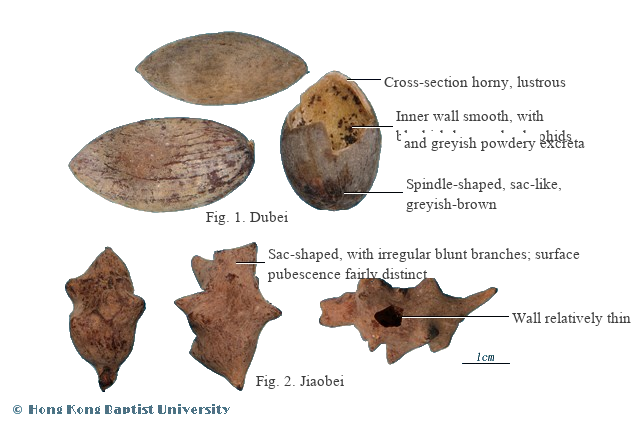
Wu Bei Zi (“five-times-multiplied gall”) is the dried gall formed on sumac leaves (Rhus chinensis) by the aphid Melaphis chinensis — a natural astringent structure that classical physicians understood as the embodiment of convergence and containment. Its cold, sour-astringent character gives it a powerful ability to draw inward and secure what leaks outward through the lungs, intestines, or uterus. Clinically it is the primary herb for chronic lung-deficiency cough, intractable diarrhea, and multiple forms of hemorrhage and excessive discharge.
Actions & Therapeutic Effects
- Astringes the lungs and stops cough — checks chronic, deficient-type cough and wheezing; also addresses hemoptysis by restraining upward leaking of lung qi and blood
- Binds the intestines and stops diarrhea — treats chronic diarrhea, dysentery, and prolapse of the rectum arising from spleen-kidney deficiency
- Stops bleeding — halts hemoptysis, hematochezia, metrorrhagia, and traumatic hemorrhage through strong astringent hemostasis
- Reduces sweating — consolidates the exterior to check both spontaneous sweating (qi deficiency) and night sweats (yin deficiency)
- Astringes essence — restrains the kidney’s holding function to address spermatorrhea and premature ejaculation
- Clears heat and reduces fire toxicity — used topically for oral ulcers, sores, burns, and weeping eczema
Clinical Applications in TCM
- Lung-deficiency chronic cough or cough with blood-streaked sputum: combined with He Zi (訶子) and Wu Wei Zi (五味子) to converge lung qi
- Chronic diarrhea and dysentery with rectal prolapse: paired with Rou Dou Kou (肉豆蔻) and Ying Su Ke (罌粟殼) in Gu Chang formulas
- Multiple hemorrhage patterns (hemoptysis, uterine bleeding, bloody stool): combined with Di Yu (地榆) and Bai Ji (白及)
- Night sweats due to yin deficiency: used with Wu Wei Zi (五味子) and Long Gu (龍骨) to anchor and consolidate
- Spermatorrhea from kidney deficiency: incorporated in Suo Jing Wan (縮精丸)-type formulations
- Topical: powdered alone or with Ku Fan (枯礬) applied to oral ulcers, bleeding wounds, and damp-weeping skin lesions
Precautions & Safety
- Dosage: 3–6 g in decoction (internal); appropriate quantity as powder, wash, or paste for external use; calcined (煅) form enhances hemostatic action
- Contraindicated in acute exterior-pattern cough or diarrhea caused by exogenous pathogens; avoid in damp-heat dysentery where astringents would trap the pathogen
- Caution in patients with urinary difficulty or constipation — the strong convergent action may further restrain fluid metabolism and bowel transit
Classical TCM Formulas
- Wu Bei Zi San (五倍子散): Wu Bei Zi single herb powder — topical for eczema, oral ulcers, and bleeding. Source: Classical topical formula.
- Zi Jin Ding (紫金锭): Shan Ci Gu, Wu Bei Zi, Qian Jin Zi, Hong Da Ji, She Xiang, Zhu Sha, Xiong Huang — for Summerheat epidemic toxin. Source: Bai Yi Xuan Fang.
- Wu Bei Zi Tang (五倍子汤): Wu Bei Zi, Wu Mei, Ke Zi — for chronic diarrhea and dysentery.
Herb Combinations
- Wu Bei Zi (五倍子) + Wu Mei (乌梅) + Ying Su Ke (罂粟壳): the strongest astringent combination for intractable chronic diarrhea — reserved for extreme conditions where gentler herbs have failed.
- Wu Bei Zi (五倍子) + Long Gu (龙骨) + Mu Li (牡蛎): astringes and secures for night sweats, spermatorrhea, and enuresis.
- Wu Bei Zi (五倍子) + Di Yu (地榆) + Bai Ji (白及): astringes and stops bleeding — for gastrointestinal bleeding and haemoptysis.
- Wu Bei Zi (五倍子) (topical powder): applied alone for eczema, weeping dermatoses, and oral ulcers — the strong astringent, desiccant action controls exudation.
Pharmacology & Research
Astringent/Hemostatic: gallotannins (60–70% tannic acid) precipitate surface proteins, contracting mucous membranes and sealing bleeding capillaries.
Antibacterial: tannic acid disrupts bacterial cell membranes, inhibiting Staphylococcus aureus, Escherichia coli, and Shigella dysenteriae.
Antiviral: gallic acid and its esters suppress viral replication, demonstrating activity against influenza A and herpes simplex virus type 1.
Anti-diarrheal: tannin-protein complexes reduce intestinal secretion and motility by binding mucosal epithelium and lowering luminal permeability.
Wound-healing: topical gallic acid accelerates epithelial regeneration and downregulates pro-inflammatory mediators at wound and ulcer sites.
Classical Descriptions
- “Wu Bei Zi: sour, astringent, cold. Descends qi, resolves phlegm, stops cough and sweating, astringes the intestines and checks dysentery, stops all manner of blood disorders.” — Bencao Gangmu (本草綱目), Li Shizhen, 1578