
Xiang Ru 香薷 — Chinese Herbal Medicine
Key Takeaways
- Nature: Slight Warm | Taste: Acrid
- Category: Acrid and warm exterior-releasing
- Latin: Herba Moslae
Xiang Ru (香薷) At a Glance
- Herb: Xiang Ru
- Chinese name: 香薷 (Xiang Ru)
- Latin name: Herba Moslae
- Nature: Slight Warm
- Taste: Acrid
- Meridian: Lung
- Category: Acrid and warm exterior-releasing
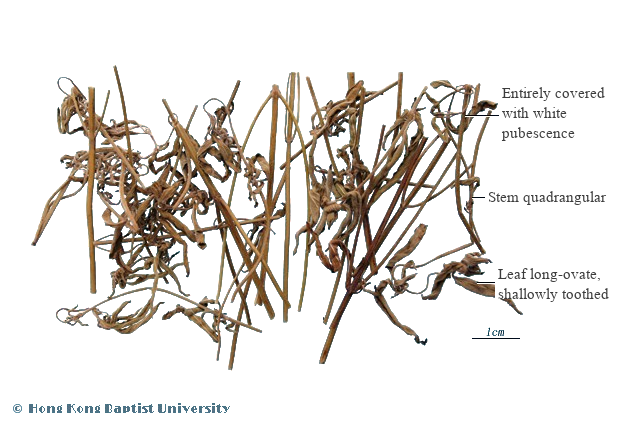
Xiang Ru (香薷, Herba Moslae) is the dried aerial parts of Mosla chinensis Maxim. (Lamiaceae), harvested in summer when the plant is in full leaf and flower. Its name — ‘aromatic rushes’ — evokes its strongly aromatic, mint-family character and its preferred habitat along waterways. Xiang Ru is famously called the ‘Summer Ma Huang’ (夏月麻黄), because it performs for summer colds what Ma Huang (Ephedra) does for winter colds: it releases the exterior and promotes sweating. However, while Ma Huang is suited for pure Wind-Cold, Xiang Ru uniquely combines exterior-releasing with Dampness-transforming and diuretic actions, making it the ideal herb for the characteristic summer pattern of ‘Wind-Cold exterior with internal Dampness’ — a common scenario when someone is caught in summer rain or sits in an air-conditioned room after sweating, trapping Damp-Cold in the body.
Actions & Therapeutic Effects
- Releases the exterior and disperses Cold — primary action for Wind-Cold in summer with Dampness; promotes sweating.
- Transforms Dampness and harmonises the Middle Jiao — treats Dampness obstructing the Spleen-Stomach with nausea, vomiting, and diarrhea.
- Promotes urination and reduces oedema — mild diuretic action, draining Dampness through the urine.
- Treats summer seasonal syndromes — especially the combination of external Wind-Cold with internal Summerheat-Dampness.
Clinical Applications in TCM
- Summer cold with chills, fever, headache, and no sweating (Wind-Cold) with nausea, vomiting, and diarrhea (internal Dampness) — Xiang Ru Yin is the classical formula
- Acute gastroenteritis in summer from consuming cold drinks with exterior exposure — combined with Hou Po and Bai Bian Dou
- Oedema from Wind-Cold obstructing the Lung with Dampness — Xiang Ru alone or with Bai Zhu
- Heatstroke (mild) — Xiang Ru decoction can promote sweating to release trapped heat
- Urinary difficulty with oedema — combined with Fu Ling and Ze Xie
- Foot Qi (beriberi) with oedema from Dampness — used with Mu Gua and Yi Yi Ren
Precautions & Safety
- Dosage: 3–10 g in decoction; add near the end (aromatic, volatile)
- Contraindicated in exterior deficiency with spontaneous sweating — the diaphoretic action may worsen
- Contraindicated in summerheat without exterior Cold — it is warming and may aggravate pure Summerheat patterns
- Li Shizhen’s warning: drink the decoction cool, not hot — hot ingestion may cause vomiting
- Contraindicated in severe fluid depletion or dehydration
- In modern practice, often serve the decoction cooled (appropriate for summer patterns)
Classical TCM Formulas
- Xiang Ru Yin (香薷饮): Xiang Ru, Hou Po, Bai Bian Dou — releases exterior, transforms Dampness, and harmonises the Middle for summer cold with Dampness. Source: Tai Ping Hui Min He Ji Ju Fang.
- Xin Jia Xiang Ru Yin (新加香薷饮): Xiang Ru, Hou Po, Jin Yin Hua, Lian Qiao, Bai Bian Dou — modified Xiang Ru Yin for summer cold with Heat signs. Source: Wen Bing Tiao Bian.
- Xiang Ru San (香薷散): Xiang Ru, Bai Zhu, Fu Ling, Ze Xie — for oedema with exterior symptoms. Source: Classical simple formula.
Herb Combinations
- Xiang Ru + Hou Po (厚朴) + Bai Bian Dou (白扁豆): the classic triplet for summer exterior Cold with internal Dampness. Source: Xiang Ru Yin (Tai Ping Hui Min He Ji Ju Fang).
- Xiang Ru + Bai Zhu (白术) + Fu Ling (茯苓): releases exterior and drains interior Dampness for oedema with exterior symptoms.
- Xiang Ru + Huo Xiang (藿香) + Pei Lan (佩兰): aromatic Dampness-transforming pair for summer Dampness with nausea and poor appetite.
- Xiang Ru + Jin Yin Hua (金银花) + Lian Qiao (连翘): for summer exterior with more pronounced Heat signs (modified Xiang Ru Yin).
Pharmacology & Research
Diaphoretic: the volatile oil (especially carvacrol and thymol) promotes cutaneous vasodilation and mild sweating.
Antimicrobial: carvacrol and thymol are potent antibacterial and antifungal agents; effective against Staphylococcus aureus, Escherichia coli, and Candida albicans.
Diuretic: flavonoids and potassium content promote mild diuresis and sodium excretion.
Antispasmodic and carminative: the essential oil relaxes gastrointestinal smooth muscle spasm and reduces intestinal cramping.
Antiviral: mosla extracts show activity against influenza virus and respiratory syncytial virus in vitro.
Classical Descriptions
- 《名医别录》(Ming Yi Bie Lu, circa 500 CE): “香薷,味辛,微温。主霍乱腹痛吐下,散水肿。” (Xiang Ru: acrid, slightly warm. Governs sudden turmoil [cholera-like gastroenteritis] with abdominal pain, vomiting, and diarrhea; disperses water-swelling.)
- 《本草纲目》(Bencao Gangmu, 1596) — Li Shizhen: “香薷,乃夏月解表之药,如冬月之麻黄。其性温,不可热饮,反致吐逆。” (Xiang Ru is the exterior-releasing medicinal of summer, like Ma Huang in winter. Its nature is warm — it must not be taken hot, otherwise it will cause vomiting and counterflow.)
- 《本草备要》(Bencao Beiyao, 1694) — Wang Ang: “香薷,辛微温。为夏月发汗之要药。解表利湿,散水和中。” (Xiang Ru: acrid, slightly warm. The essential diaphoretic of summer. Releases the exterior and drains Dampness; disperses water and harmonises the Middle.)