
Xiong Huang 雄黄 — Chinese Herbal Medicine
Key Takeaways
- Nature: Warm | Taste: Acrid, Bitter
- Category: Topical medication
- Latin: Realgar (Arsenicum Disulfide, As₂S₂)
Xiong Huang (雄黄) At a Glance
- Herb: Xiong Huang
- Chinese name: 雄黄 (Xiong Huang)
- Latin name: Realgar (Arsenicum Disulfide, As₂S₂)
- Nature: Warm
- Taste: Acrid, Bitter
- Meridian: Heart
- Category: Topical medication
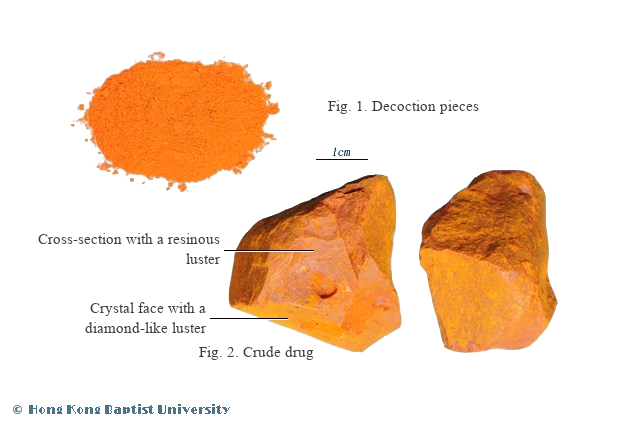
Xiong Huang (雄黄), known in Western herbalism as Realgar, is an arsenic disulfide mineral classified as a topical medication in Traditional Chinese Medicine. Its warm, acrid, and bitter properties allow it to resolve fire toxins, kill parasites, dry dampness, and expel phlegm. Historically prized for its vivid orange-red color, it was burned as incense during the Dragon Boat Festival to ward off pestilence and toxic creatures.
Actions & Therapeutic Effects
- Resolves fire toxins and reduces swelling
- Kills parasites and relieves itching
- Dries dampness and transforms phlegm
- Disperses accumulations and stops pain
- Expels malaria pathogens
Clinical Applications in TCM
- Carbuncles, furuncles, and toxic sores — applied topically or used in Xiong Huang Jie Du San (雄黄解毒散)
- Scabies, ringworm, and dermal parasites — combined with Bai Fan (白矾) in topical washes
- Snake and insect bites — powdered and applied directly to the wound
- Intestinal roundworm or pinworm — taken in small internal doses with Ku Lian Pi (苦楝皮) and Bing Lang (槟榔)
- Malarial disorders with alternating chills and fever — combined with Chang Shan (常山) in decoction
- Phlegm obstruction causing seizures or loss of consciousness — used in Xing Xiao Wan (醒消丸)
Precautions & Safety
- Topical dosage: 0.05–0.1 g powdered; internal use strictly 0.05–0.1 g maximum and rarely indicated
- Absolutely contraindicated in pregnancy — strongly emmenagogic and teratogenic
- Contraindicated in liver or kidney insufficiency due to arsenic accumulation
- Never heat or calcine — oxidation produces arsenous oxide (As₂O₃), acutely lethal
- Avoid prolonged internal use; monitor for chronic arsenic toxicity (peripheral neuropathy, skin changes)
Classical TCM Formulas
- An Gong Niu Huang Wan (安宫牛黄丸) historically contained Xiong Huang for severe febrile coma.
- Zi Jin Ding (紫金锭) historically used Xiong Huang. Source: Bai Yi Xuan Fang.
- Xiong Huang is of primarily historical/toxicological interest; modern arsenicals are strictly regulated pharmaceuticals.
Herb Combinations
- Xiong Huang (雄黄) + Bai Fan (白矾) + Bing Pian (冰片) (topical): historical emergency treatment for snake bite and furunculosis.
- MODERN WARNING: Xiong Huang is restricted/banned in most countries; safer non-arsenic alternatives exist.
- Arsenic trioxide injection is a regulated pharmaceutical for APL — NOT interchangeable with crude Xiong Huang.
Pharmacology & Research
Antimicrobial: inhibits Staphylococcus aureus, Streptococcus pyogenes, and common dermatophytes.
Antiparasitic: disrupts cellular respiration in intestinal helminths and ectoparasites.
Antineoplastic: arsenic compounds induce apoptosis in leukemic and solid-tumor cell lines (investigational).
Anti-inflammatory: reduces topical edema and suppresses local inflammatory mediators.
Toxic threshold: systemic arsenic absorption occurs through damaged skin; monitor in ulcerated lesions.
Classical Descriptions
- “Xiong Huang is acrid, warm, and toxic. It governs malicious qi of cold and heat, kills ghost spirits, eliminates all poisons, and controls the hundred parasites.”
- — Shennong Bencao Jing (神农本草经), Chapter 2