
Ying Su Ke 罂粟壳 — Chinese Herbal Medicine
Key Takeaways
- Nature: Neutral | Taste: Acid, Astringent
- Category: Strengthens the lungs and relieves asthma/astringes the large intestine
- Latin: Papaveris Pericarpium
Ying Su Ke (罂粟壳) At a Glance
- Herb: Ying Su Ke
- Chinese name: 罂粟壳 (Ying Su Ke)
- Latin name: Papaveris Pericarpium
- Nature: Neutral
- Taste: Acid, Astringent
- Meridian: Lung
- Category: Strengthens the lungs and relieves asthma/astringes the large intestine
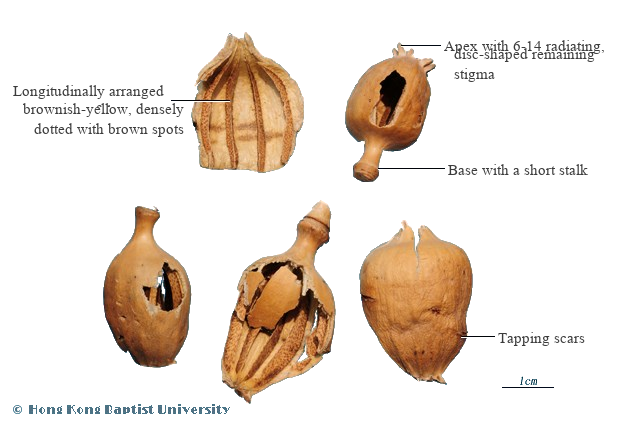
The name 罂粟壳 (yīng sù ké) translates literally as “poppy shell” — the dried pericarp of Papaver somniferum harvested after the seed is removed, its sour and astringent character reflecting a strong capacity to gather, consolidate, and restrain. Among the most potent astringents in the classical materia medica, it acts swiftly on both the Lung and Large Intestine to halt what has gone on too long and can no longer resolve on its own. Its primary clinical role is the management of chronic, intractable cough, wheezing, diarrhea, and dysentery of the deficiency type, always prescribed short-course and never when a pathogen remains.
Actions & Therapeutic Effects
- Astringes the intestines and stops diarrhea — for chronic slippery diarrhea and dysentery with Spleen-Kidney deficiency and failing containment
- Constrains Lung qi and relieves cough and asthma — for persistent, exhausting cough or wheezing due to Lung deficiency with rebellious qi
- Moderates pain — for chronic abdominal, epigastric, and musculoskeletal pain of the deficiency type via smooth-muscle relaxation and analgesic action
- Secures and consolidates — broadly arrests pathological leakage (bowels, Lung qi) in prolonged deficiency conditions where essence and qi are failing to hold
Clinical Applications in TCM
- Chronic deficiency diarrhea and dysentery with slippery stool: combine with He Zi, Rou Dou Kou, and Bai Zhu — as in Zhen Ren Yang Zang Tang (真人養臟湯)
- Protracted dysentery with residual damp-heat, pus, and blood: pair with Huang Lian and Mu Xiang to astringe while clearing the lingering pathogen
- Intractable Lung-deficiency cough with thin watery phlegm: combine with Wu Wei Zi, Wu Mei, and Xing Ren to restrain qi and descend the Lung
- Chronic asthma with shortness of breath on exertion: used with Ge Jie and Bu Gu Zhi to consolidate Lung and Kidney and anchor qi
- Chronic abdominal pain with cold-deficiency presentation: added in small amounts to warming, tonifying formulas to moderate pain without masking pattern
- Prolapsed rectum with persistent diarrhea: combined with Huang Qi and Sheng Ma to lift and astringe simultaneously
Precautions & Safety
- Dosage: 3–6 g in decoction; honey-frying (mi zhi, 蜜炙) moderates dryness and enhances Lung action; maximum course 5–7 days; do not exceed dosage
- Contraindicated in all exterior or excess patterns, new-onset cough, early-stage dysentery, or acute infections — astringency will trap the pathogen and worsen the condition
- Contraindicated in pregnancy, children under 14, and patients with respiratory insufficiency or reduced consciousness; prolonged use produces dependence; classified as a controlled or scheduled substance in most jurisdictions and requires prescription handling
Classical TCM Formulas
- Ke Li San (咳利散): Ying Su Ke, Wu Mei, Wu Wei Zi, Bai Guo — chronic cough and diarrhea. Source: Classical astringent formula (now largely historical due to regulatory restrictions).
- Modified Jiu Xian San (九仙散): Ren Shen, Ying Su Ke, Wu Wei Zi, Wu Mei, E Jiao, Jie Geng, Kuan Dong Hua, Sang Bai Pi, Bei Mu — chronic cough from Lung Qi deficiency. Source: Wei Sheng Jia Bao.
- Modern regulatory note: Ying Su Ke is a controlled substance in most countries; dextromethorphan, codeine (pharmaceutical), or non-narcotic herbal alternatives are preferred.
Herb Combinations
- Ying Su Ke (罂粟壳) + Wu Mei (乌梅) + Wu Wei Zi (五味子): triple astringent for chronic, dry cough from Lung Yin deficiency — Ying Su Ke suppresses cough centrally, the sour herbs astringe Lung Qi.
- Ying Su Ke (罂粟壳) + Ke Zi (诃子) + Bai Guo (白果): astringes the Lung and stops chronic cough and wheezing.
- Ying Su Ke (罂粟壳) + Bai Zhu (白术) + Shan Yao (山药): astringes the Intestine and strengthens the Spleen for chronic diarrhea.
- Ying Su Ke (罂粟壳) + Dang Shen (党参) + Huang Qi (黄芪): astringes while tonifying for chronic conditions with significant deficiency.
Pharmacology & Research
Opioid alkaloids (morphine, codeine): bind μ- and κ-opioid receptors to produce dose-dependent analgesia, antitussive action, and reduced intestinal motility.
Isoquinoline alkaloids (papaverine, noscapine): relax smooth muscle via phosphodiesterase inhibition; contribute antispasmodic and accessory antitussive effects independent of opioid pathways.
Organic acids and mucilage: provide direct astringent action on intestinal and bronchial mucosa, supporting the classical astringe-and-consolidate function at the tissue level.
Classical Descriptions
- “止瀉痢,固脫肛,治遺精久咳,斂肺,澀腸,止心腹筋骨諸痛。” — Běn Cǎo Gāng Mù (本草綱目), Li Shi Zhen, 1578 (“Stops diarrhea and dysentery, secures prolapsed rectum, treats nocturnal emission and chronic cough, astringes the Lung and intestines, stops pain in the heart, abdomen, muscles, and bones.”)