
Yu Yu Liang 禹余粮 — Chinese Herbal Medicine
Key Takeaways
- Nature: Neutral | Taste: Sweet, Astringent
- Category: To stop diarrhea by closing the large intestine
- Latin: Limonitum
Yu Yu Liang (禹余粮) At a Glance
- Herb: Yu Yu Liang
- Chinese name: 禹余粮 (Yu Yu Liang)
- Latin name: Limonitum
- Nature: Neutral
- Taste: Sweet, Astringent
- Meridian: Large Intestine
- Category: To stop diarrhea by closing the large intestine
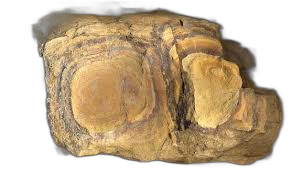
Yu Yu Liang (禹余粮), known in Latin as Limonitum, is a mineral substance derived from hydrated iron oxide (goethite/limonite). Its name translates as “Yu’s remaining grain,” an allusion to the legendary Emperor Yu who tamed the great floods — the herb was said to be what he left behind after his labors. Neutral in nature with a sweet and astringent taste, it enters the Large Intestine meridian and belongs to the category of herbs that stop diarrhea by closing and consolidating the bowel. It is primarily indicated for patterns of lower jiao instability, including chronic diarrhea, dysentery that lingers after the pathogen has cleared, uterine bleeding, and abnormal vaginal discharge. As a mineral herb, it is heavy, sinking, and consolidating in character — qualities that define both its clinical strengths and its contraindications.
Actions & Therapeutic Effects
- **Astringes the intestines and stops diarrhea:** Indicated for chronic diarrhea, persistent dysentery after the pathogenic factor has been cleared, and rectal prolapse associated with sinking of qi and failure of the large intestine to consolidate.
- **Stops uterine bleeding and secures the lower jiao:** Used for metrorrhagia and metrostaxis (崩漏) and for profuse, persistent vaginal discharge (带下) due to deficiency and insecurity of the lower jiao.
- **Consolidates essence and contains leakage:** Applied in patterns of seminal emission, frequent urination, or other conditions of the lower jiao failing to hold, typically in combination with kidney-securing herbs.
Clinical Applications in TCM
- **Chronic diarrhea and persistent dysentery:** The classic pairing is with Chi Shi Zhi (赤石脂), as recorded in the *Shang Han Lun* formula 赤石脂禹余粮汤 — used when repeated purging has depleted the middle and lower jiao and the bowel can no longer consolidate.
- **Uterine bleeding (崩漏):** Combined with Hai Piao Xiao (海螵蛸), Zong Lu Tan (棕榈炭), and Xue Yu Tan (血余炭) to astringe and stop hemorrhage.
- **Leukorrhea (带下):** Paired with Qian Shi (芡实), Lian Zi (莲子), and Shan Yao (山药) to secure and astringe the lower jiao.
- **Rectal prolapse with qi sinking:** Used alongside Huang Qi (黄芪) and Sheng Ma (升麻) to consolidate while lifting.
Precautions & Safety
- **Contraindicated while pathogenic factors remain:** Being a strong astringent, Yu Yu Liang must not be used for acute diarrhea or dysentery where damp-heat or an exterior pathogen is still present — consolidating at this stage traps the evil and worsens the condition.
- **Use with caution in pregnancy:** Its heavy, sinking, consolidating nature is generally considered unsuitable during pregnancy, especially in higher doses.
- **Decoct first (先煎, xiān jiān):** As a mineral substance, it must be added to the pot 20–30 minutes before other herbs to ensure proper extraction and reduce any harsh mineral edge.
- **Avoid prolonged unsupervised use:** Extended administration of mineral herbs requires monitoring due to accumulation of iron and trace silicates.
- **Not for damp-heat patterns without modification:** If damp-heat is an underlying factor, appropriate clearing herbs (e.g., Huang Lian, Huang Bai) should be combined before astringents are introduced.
Classical TCM Formulas
- Chi Shi Zhi Yu Yu Liang Tang (赤石脂禹余粮汤): Chi Shi Zhi, Yu Yu Liang — the two mineral astringents for chronic diarrhea unresponsive to Spleen-tonifying formulas. Source: Shang Han Lun.
- Yu Yu Liang Wan (禹余粮丸): Yu Yu Liang, Hai Piao Xiao, Qian Shi, Bai Zhu — chronic leukorrhea from deficiency. Source: Ji Sheng Fang.
- Gu Chong Tang (固冲汤) with Yu Yu Liang: Bai Zhu, Huang Qi, Long Gu, Mu Li, Shan Zhu Yu, Bai Shao, Hai Piao Xiao, Qian Cao, Zong Lu Tan + Yu Yu Liang — severe uterine bleeding.
Herb Combinations
- Yu Yu Liang (禹余粮) + Chi Shi Zhi (赤石脂): the two mineral astringents — the core pair for chronic diarrhea and dysentery with bleeding. Source: Chi Shi Zhi Yu Yu Liang Tang (Shang Han Lun).
- Yu Yu Liang (禹余粮) + Hai Piao Xiao (海螵蛸) + Qian Shi (芡实): mineral-animal-plant astringent triad for chronic leukorrhea and uterine bleeding.
- Yu Yu Liang (禹余粮) + Bai Zhu (白术) + Fu Ling (茯苓): astringes while strengthening the Spleen for chronic diarrhea with Spleen deficiency.
- Yu Yu Liang (禹余粮) + Duan Long Gu (煅龙骨) + Duan Mu Li (煅牡蛎): strongly astringes and secures for flooding uterine bleeding.
Pharmacology & Research
– **Primary constituents:** Hydrated iron oxide (goethite, FeO·OH) as the principal component, along with silicates, calcium carbonate, magnesium compounds, and trace amounts of aluminum and manganese.
– **Astringent and antidiarrheal action:** The dense mineral matrix absorbs intestinal secretions and reduces mucosal irritability; the silicate fraction acts similarly to kaolin, a mechanism well-documented in mineral-based antidiarrheal preparations.
– **Hemostatic properties:** Iron compounds support platelet aggregation and reduce capillary permeability, consistent with its classical application in uterine hemorrhage and rectal bleeding.
– **Antimicrobial activity:** Limited in vitro evidence suggests iron oxide compounds may inhibit certain enteric pathogens, offering a partial rationale for its historical use in dysentery — though this use is appropriate only after the acute phase has resolved.
– **Note:** Formal pharmacological research on Yu Yu Liang remains sparse compared to botanical TCM herbs; its applications rest primarily on classical documentation and centuries of clinical empirical use.
Classical Descriptions
- 《神农本草经》(Shennong Bencao Jing):** “Yu Yu Liang is sweet in flavor, cold in nature. It governs the five hemorrhoids, consolidates the lower jiao, stops diarrhea, and removes damp bi.”
- 《伤寒论》(Shang Han Lun), Zhang Zhongjing — 赤石脂禹余粮汤:** “For the condition where, after repeated purging, the diarrhea cannot be stopped — the fault lies not with the middle jiao but with the lower jiao; treat with Chi Shi Zhi Yu Yu Liang Tang.” This formula pairs equal parts Yu Yu Liang and Chi Shi Zhi, establishing the definitive classical use of this herb for intractable diarrhea from lower jiao insecurity.
- 《本草纲目》(Bencao Gangmu), Li Shizhen:** “It enters the blood division of the Stomach and Large Intestine. Its astringing and consolidating action is suited to conditions where qi and blood have sunk and the jiao cannot hold. It is heavier than Chi Shi Zhi and thus descends more decisively to the lower jiao.”
- 《本草经疏》(Bencao Jing Shu), Miao Xiyong:** “All chronic bleeding disorders of the lower body — hemorrhage, dysentery, leukorrhea — benefit from its consolidating virtue, provided no pathogen remains.”